
Smartphone Specs Decoded: What the Numbers Actually Mean
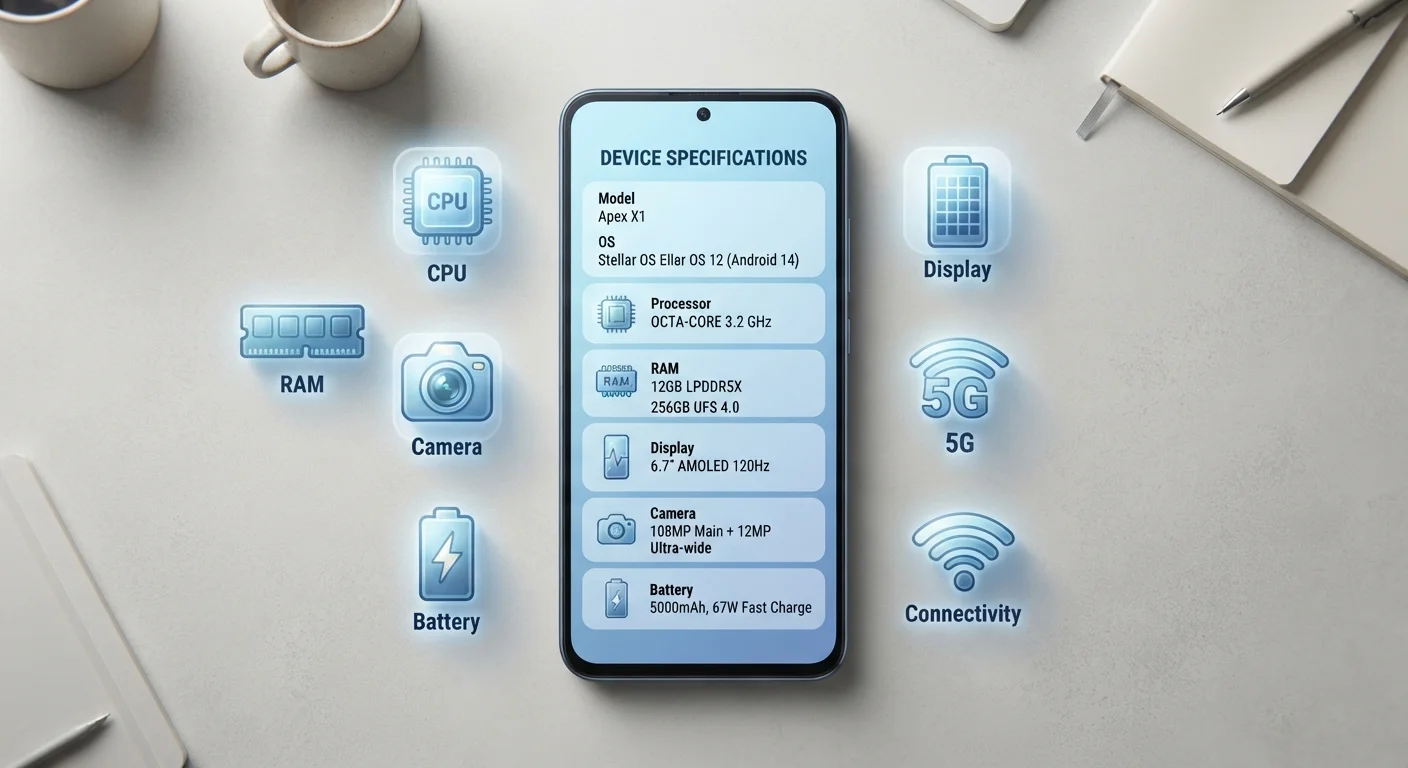
Photo credit: SearchLynk.net | Search Made Easier
In this article
RAM, GHz, nits, and megapixels—learn what each spec genuinely affects in day-to-day phone use.
Key Takeaways
- More megapixels don't automatically mean better photos - sensor size and software processing matter more.
- RAM determines how many apps stay open at once; storage holds your files, photos, and apps permanently.
- Processor clock speed (GHz) is one factor in performance, but chip architecture and efficiency matter equally.
- Screen brightness (measured in nits) affects outdoor readability; refresh rate affects scrolling smoothness.
- Battery capacity in mAh is only meaningful alongside the phone's power efficiency and display size.
- Spec comparisons are most useful when you match numbers to your actual daily habits and use cases.
RAM and Storage: Two Very Different Things
One of the most persistent points of confusion in smartphone specs is the difference between RAM and storage - and they genuinely do different jobs. RAM (Random Access Memory) is your phone's short-term working memory. It holds the apps and processes you're actively using so you can switch between them without waiting for everything to reload. Storage - often called internal memory - is where your photos, videos, downloaded apps, and files live permanently.
A phone with more RAM handles multitasking more gracefully: switching between a browser, a messaging app, and a streaming service without stuttering. Storage capacity, on the other hand, determines how much content you can keep on the device. Running out of storage is a common frustration; running low on RAM typically just slows things down temporarily. Our plain-English reference on storage, RAM, and processing power covers this distinction in further detail.
12 MP
Megapixels sufficient for most everyday photography
Camera experts broadly agree that sensor quality and software processing outpace raw megapixel counts at this threshold for standard use cases.
120 Hz
Refresh rate that delivers visibly smoother scrolling
Display researchers note that most users can perceive the difference between 60 Hz and 120 Hz, but gains above 120 Hz are far less noticeable in everyday tasks.
1,000+ nits
Peak brightness needed for direct-sunlight readability
Display industry guidelines generally place the threshold for comfortable outdoor visibility at or above 1,000 nits peak brightness.
Processors: What GHz and Cores Actually Tell You
The processor - sometimes called the SoC (System on a Chip) - is the engine of your smartphone. Manufacturers describe it using clock speed (GHz) and core count, but neither number tells the full story on its own.
Clock speed measures how many operations a chip completes per second. More GHz can mean faster processing, but chip architecture - the underlying design - matters just as much. A newer chip running at a lower GHz may comfortably outperform an older design at higher speeds. Core count matters too: most modern phones use a mix of high-performance and efficiency cores that activate depending on the task, balancing speed with battery draw. The practical takeaway: compare chips within the same generation and product tier rather than chasing raw GHz figures.
“A chip's architecture determines how efficiently it executes instructions - clock speed alone is a poor proxy for real-world performance, especially as manufacturers optimize for mixed workloads across performance and efficiency cores.”
— Chip Design & Mobile Architecture Research Community, Consensus view among semiconductor and mobile hardware analysts
Camera Megapixels: Resolution Isn't Everything
Megapixels measure the number of light-capturing pixels on a camera sensor. More pixels mean higher resolution images - in theory. In practice, three other factors often matter more:
- Sensor size: A physically larger sensor captures more light per pixel, producing better results in low-light conditions regardless of megapixel count.
- Aperture: Expressed as an f-number (e.g., f/1.8), a wider aperture lets in more light. Lower f-numbers indicate wider apertures.
- Computational photography: Software algorithms that process, stack, and enhance images have transformed what smartphone cameras can do, often delivering better results than raw hardware specs would suggest.
For most users sharing photos to social media or printing standard-sized prints, 12-16 megapixels is genuinely sufficient. Very high megapixel counts are useful primarily for cropping or producing large prints.
Screen Specs: Nits, Refresh Rate, and Resolution
Display specifications use several distinct measurements, each affecting a different aspect of how the screen looks and feels in use.
Brightness (nits): A nit is a unit of luminance. Outdoor readability in direct sunlight generally requires peak brightness above 1,000 nits; many modern phones reach 2,000 nits or more under peak conditions. Refresh rate (Hz): This measures how many times per second the screen updates. A 60 Hz screen refreshes 60 times per second; a 120 Hz screen does so twice as fast, making scrolling and animations look noticeably smoother - at a cost to battery life if not managed adaptively. Resolution describes pixel density, typically expressed in PPI (pixels per inch). Above roughly 300 PPI, individual pixels are difficult for most people to distinguish at normal viewing distances. Our article on always-on displays, refresh rates, and brightness explores how these features interact in day-to-day use.
Battery Capacity and What mAh Really Means
mAh (milliampere-hours) measures how much energy a battery can store. A 5,000 mAh battery stores more energy than a 3,500 mAh battery - but how long that energy lasts depends on what's consuming it. Screen size and technology, processor efficiency, network connectivity, and usage habits all affect real-world battery life significantly.
Manufacturers sometimes also quote charging speeds in watts (W). Higher wattage charging refills the battery faster, though it can generate more heat during the process. Understanding what affects battery health over time is equally important for the long run - see our guide on why phone batteries degrade and what slows it down for the underlying science.
If long-term device ownership is a goal, pairing realistic spec expectations with good usage habits makes a meaningful difference. Our article on keeping a smartphone for four or five years covers practical strategies for extending device life.
Frequently Asked Questions

Author
Tech & Telecom Editorial Team
Tech & Telecom Editorial Team is the collective byline for our editorial team and contributor network. Articles published under this byline or an editorial pen name are researched, written, and reviewed according to our editorial standards for clarity, consistency, and independence before publication.
View all articles →