
Budgeting at Every Stage of Adult Life
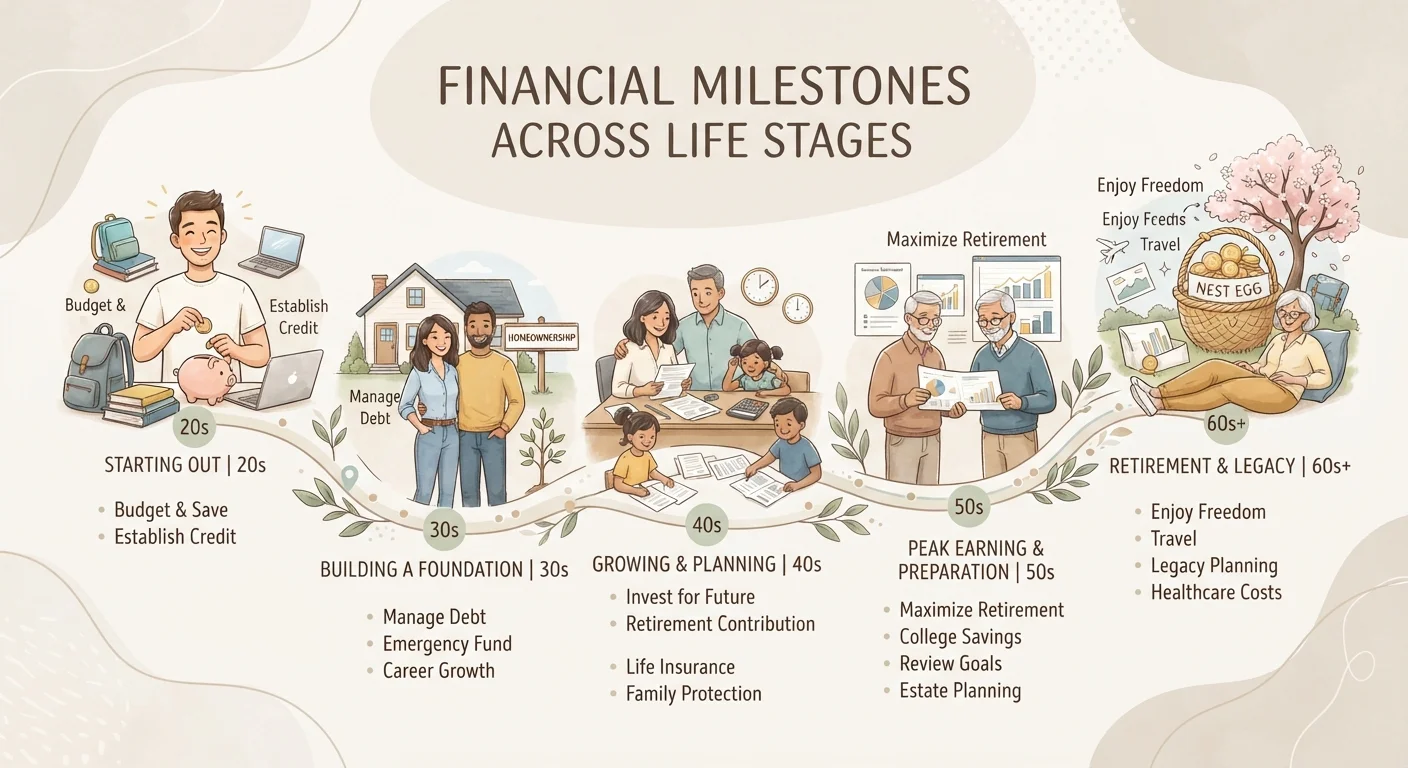
Photo credit: SearchLynk.net | Search Made Easier
In this article
Your financial priorities shift dramatically from your 20s through retirement. This end-to-end guide covers how a sensible budget evolves with your life.
Key Takeaways
- Financial priorities shift significantly across each decade of adult life, requiring budget adjustments.
- Your 20s are critical for forming habits: emergency funds and debt reduction set the tone for decades ahead.
- Retirement budgeting demands a shift from accumulation to sustainable withdrawal - sequence matters.
- A consistent review cadence keeps your budget aligned with life changes at any age.
- Core frameworks like the 50/30/20 rule can be adapted to fit almost any life stage.
Why Budgeting Looks Different at Every Life Stage
A budget is not a static document. It is a living plan that must flex as your income, obligations, and goals evolve. The graduate navigating student loan payments has almost nothing in common financially with the empty-nester mapping retirement income - yet both benefit from the same discipline: intentional allocation of money toward what matters most.
Understanding why priorities shift helps you adapt rather than abandon your plan when life changes. If you are newer to personal finance concepts, the budgeting terms reference guide is a useful starting point before diving in.
This guide walks through each major adult life stage, identifying the financial realities, key budget priorities, and practical adjustments that tend to serve people well at each phase. It is general financial education - not personalized advice. Consider working with a licensed financial professional for guidance specific to your situation.
Your 20s: Building Financial Foundations
Early adulthood is often characterized by modest income, significant debt - frequently student loans - and lifestyle expenses that can quietly derail long-term goals. The decisions made in this decade, however, compound powerfully over time.
Core Budget Priorities
- Emergency fund first. Aim to build three to six months of essential expenses in a liquid savings account before aggressively tackling other goals.
- Attack high-interest debt. Credit card balances carrying double-digit interest rates erode wealth faster than most investments can build it.
- Start retirement contributions early. Even small contributions to a workplace retirement account can grow substantially over 40-plus years due to compounding.
A useful framework for this stage is the 50/30/20 rule: roughly 50% of take-home pay toward needs, 30% toward wants, and 20% toward savings and debt repayment. For a step-by-step approach to building this out, see how to build a monthly budget you'll actually stick to.
Automate your savings the day your paycheck arrives - before you have a chance to spend it. Even $50 a month in your 20s builds a habit that scales as income grows.
Behavioral finance research consistently shows that removing the decision from the equation - through automatic transfers - dramatically increases follow-through on savings goals.
When your income rises, resist letting your lifestyle rise at the same rate. Redirect at least half of every raise or bonus to savings or debt before adjusting your spending baseline.
Lifestyle inflation is the primary reason many high earners still find themselves financially unprepared for retirement - incremental discipline over decades makes an outsized difference.
Your 30s: Balancing Growth and Competing Priorities
Income typically rises in this decade, but so do expenses - often sharply. Marriage, children, homeownership, and career pivots can all arrive at once, making the 30s the most financially complex stage for many Americans.
Core Budget Priorities
- Housing costs. A common guideline is to keep total housing costs (mortgage or rent, taxes, insurance) below 28-30% of gross monthly income.
- Child-related expenses. Childcare, education savings accounts, and increased insurance coverage can significantly alter monthly cash flow.
- Life and disability insurance. Dependents create financial obligations that need protection if primary income is disrupted.
The 30s are also when lifestyle inflation - spending more simply because you earn more - quietly undermines savings rates. Automating savings transfers before discretionary money hits a checking account is one of the most reliable defenses against this pattern. Building budgeting habits that hold up over time becomes especially valuable here.
57%
Americans without a written budget
A recurring finding in national financial literacy surveys suggests that fewer than half of U.S. adults consistently follow a formal budget.
3-6 months
Recommended emergency fund coverage
The general guidance from financial educators is to hold three to six months of essential expenses in accessible savings before focusing on other financial goals.
$0
Retirement savings for many Americans in their 30s
Federal Reserve surveys have consistently found a substantial share of working-age adults have little or no dedicated retirement savings.
Your 40s: Peak Earning, Peak Spending
For many households, the 40s represent peak income years - but also peak spending. College funding pressures, aging-parent support, mortgage payoff timelines, and retirement acceleration all compete for the same dollars.
Core Budget Priorities
- Retirement catch-up. If contributions have lagged, the 40s are the time to increase them meaningfully. Tax-advantaged accounts have annual contribution limits worth maximizing.
- College planning clarity. Balancing your retirement savings against children's education costs is a genuine trade-off. Financial educators generally advise prioritizing retirement, since loans exist for education but not for retirement income.
- Insurance review. Long-term care insurance becomes more relevant and often more affordable when purchased before age 60.
This is also a good decade to stress-test your budget against potential income disruption - job loss, health events, or a career change can materially affect a household that has grown accustomed to two incomes. Explore strategies for building savings and managing debt to shore up your financial resilience.
Your 50s and Early 60s: The Pre-Retirement Stretch
The decade or so before retirement is a critical planning window. Income is often at its highest, children may be financially independent, and the mortgage may be nearing payoff - creating meaningful budget flexibility that should be directed with precision.
Core Budget Priorities
- Maximize retirement contributions. Adults 50 and older qualify for catch-up contributions to 401(k)s and IRAs, allowing higher annual deposits than younger savers.
- Model retirement income. Begin estimating what Social Security, pensions, and portfolio withdrawals will realistically provide. Compare that to projected expenses.
- Reduce fixed expenses. Paying off the mortgage, downsizing a vehicle, or eliminating recurring subscriptions reduces the income you'll need in retirement.
Health costs deserve special attention here. Out-of-pocket medical expenses tend to rise with age, and the gap between retirement and Medicare eligibility at 65 can be expensive to bridge with private coverage. A budget that ignores healthcare risk in this phase is incomplete. For a broader perspective on how health needs shift with age, fitness considerations by decade offers useful context alongside financial planning.
Don't Raid Retirement Savings Early
Withdrawing from a 401(k) or IRA before age 59½ typically triggers income taxes plus a 10% early withdrawal penalty, and permanently removes money that would otherwise compound. In financially stressful periods, it can feel like the obvious solution - but the long-term cost is usually far higher than it appears. Exhaust other options, including emergency funds, before considering early retirement withdrawals.
Retirement: Budgeting on a Fixed Income
Retirement fundamentally changes the budget equation. Instead of allocating income toward future goals, the focus shifts to sustaining withdrawals from accumulated assets without outliving your money. This requires a different kind of discipline.
Core Budget Priorities
- Establish a withdrawal rate. Financial planners often discuss the 4% guideline as a starting point - withdrawing roughly 4% of a portfolio annually - though this is a general heuristic, not a guarantee, and depends on portfolio size, sequence of returns, and longevity.
- Separate essential from discretionary spending. Cover fixed costs (housing, healthcare, food) with reliable income sources like Social Security or pensions; use portfolio withdrawals for discretionary expenses.
- Revisit annually. Spending patterns in retirement shift - often heavier in early active years, lower mid-retirement, then potentially higher again due to healthcare costs late in life.
Sequence-of-returns risk - the danger of major market losses early in retirement - can permanently impair a withdrawal strategy even if long-run returns are acceptable. Holding a cash or short-term bond buffer can help retirees avoid selling investments at depressed prices during downturns.
For those building toward this stage, the investing essentials hub covers foundational concepts relevant to retirement portfolio construction.
This article is for general informational and educational purposes only. It does not constitute personalized financial, tax, investment, or legal advice. Consult a qualified financial professional for guidance tailored to your specific circumstances.

Author
Finance Editorial Team
Finance Editorial Team is the collective byline for our editorial team and contributor network. Articles published under this byline or an editorial pen name are researched, written, and reviewed according to our editorial standards for clarity, consistency, and independence before publication.
View all articles →