
Sale Price vs. True Savings: Why the Original Price Doesn't Always Mean What You Think
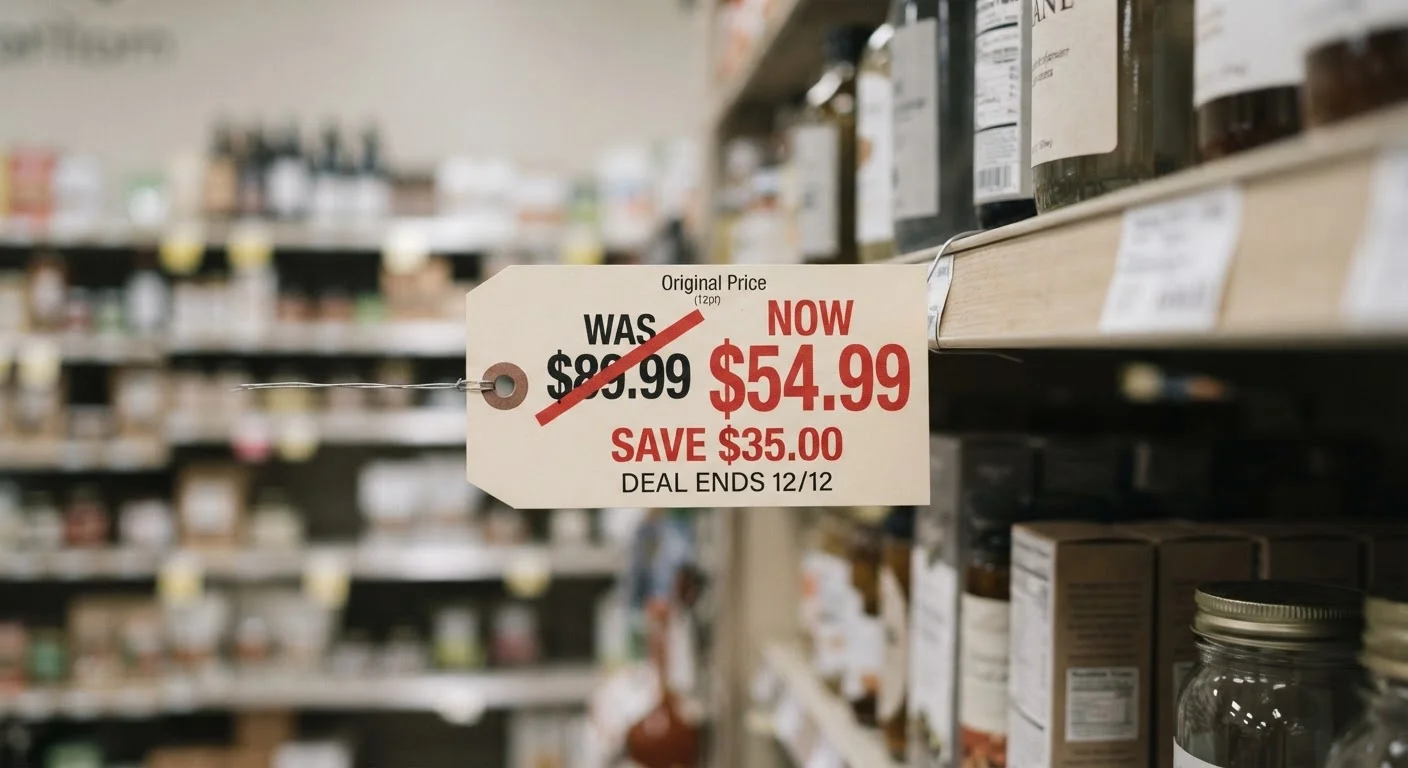
Photo credit: SearchLynk.net | Search Made Easier
In this article
Inflated 'original' prices make discounts look bigger than they are. Understand how reference pricing works and how to spot a genuine deal.
Key Takeaways
- Retailers can legally set inflated 'original' prices to make discounts appear larger than they are.
- Price history tools reveal whether a sale price is genuinely lower than the item's typical selling price.
- Regulatory standards for reference pricing vary by state, so consumers need independent verification strategies.
- A lower sticker price does not automatically mean better value - total cost of ownership matters too.
How Reference Pricing Works - and Why It's Designed to Influence You
When you see a product marked "Was $120, Now $60," your brain registers a 50% saving before you've evaluated whether the item is worth $60 at all. This is reference pricing in action: the original or "was" price anchors your perception of value, making the current price feel like a windfall regardless of what the item normally sells for.
The Federal Trade Commission (FTC) has long-standing guidance stating that a former price used as a reference should be a genuine, recent price at which the item was actually offered for a meaningful period. In practice, enforcement is inconsistent, and some retailers set an elevated "list" price that few or no consumers ever paid - then immediately discount from it. The result is a deal that exists largely on paper.
Understanding this mechanism is the first step toward evaluating any advertised discount on its actual merits rather than its theatrical framing. For a broader look at how extreme discounts can signal deeper problems, see our guide on why deeply discounted products often aren't real.
Myth
The original price listed next to a sale price reflects what the item genuinely sold for before the discount.
Fact
Retailers are not always required to prove an item sold at the reference price for any meaningful period or volume.
Many jurisdictions allow retailers to use a "manufacturer's suggested retail price" (MSRP) or an internal list price as the reference - even if no consumer ever purchased the item at that amount. The FTC provides guidance against deceptive former-price advertising, but enforcement typically responds to complaints rather than proactively auditing every tag. State laws vary considerably; some states have stricter requirements than others. The practical implication: treat the crossed-out price as information to investigate, not a confirmed fact.
Myth
A larger percentage discount always means a better deal.
Fact
Percentage off is only meaningful relative to an accurate baseline price - and it says nothing about whether the item is worth buying at all.
A 70% discount on a product priced at three times its market value leaves you paying 10% above what competitors charge at full price. Percentage framing also distracts from absolute value: saving 40% on a $10 item is $4; saving 5% on a $400 item is $20. Before responding to a percentage, identify the item's typical market price from independent sources, then assess whether the sale price is genuinely below that level.
Myth
Sale events like major shopping holidays reliably offer the lowest prices of the year.
Fact
Price tracking data consistently shows that many items reach the same or lower prices at other times of year.
Academic research and consumer advocacy organizations have repeatedly found that a notable share of items promoted during high-profile sale events were available at the same price - or cheaper - in the weeks before or after. Some products are temporarily raised before the event window so the "discount" appears larger. Price history tools that log daily prices make this pattern visible and help consumers decide whether to wait, buy, or pass.
Myth
If a store advertises a sale, consumer protection law guarantees the discount is legitimate.
Fact
Legal standards for reference pricing exist, but they are inconsistent across states and do not guarantee every advertised discount reflects a real prior selling price.
The FTC's guidelines on deceptive pricing are federal, but civil enforcement often falls to state attorneys general, whose resources and priorities vary. Class-action lawsuits against major retailers for inflated reference prices have resulted in settlements, but the practice remains widespread. Consumers cannot rely solely on legal protection - independent price verification remains the most effective personal defense. For related context on deceptive deal tactics, visit the Avoiding Scams hub.
Myth
Clearance prices are always the final markdown and represent the item's true lowest price.
Fact
Clearance pricing follows its own retail logic and does not guarantee the price is below what competitors charge or what the item is objectively worth.
Clearance sections often contain discontinued, end-of-season, or overstocked items. While prices are reduced from a store's internal price, that internal price may itself have been inflated, and competing retailers may carry the same or similar items at lower everyday prices. Clearance items also frequently carry no return or exchange policy, meaning a seemingly good price can become a loss if the product is defective or unsuitable. Always compare and confirm the return policy before purchasing clearance goods.
How to Verify Whether a Price Drop Is Genuine
The most reliable way to cut through reference pricing noise is to check an item's actual price history before buying. Price tracking tools record historical prices at major retailers, giving you a factual baseline instead of a retailer-supplied anchor.
~60%
Of "sale" items not at their lowest price during major retail events
Consumer advocacy analyses of major shopping events have found that a substantial share of promoted items were available at equivalent or lower prices at other points during the same year.
3+
Retailers to cross-check before accepting a sale price
Shopping researchers generally recommend checking at least three independent sources to establish a realistic market price before treating any single retailer's reference price as valid.
Beyond price history, consider the following habits:
- Search the item across multiple retailers on the same day. If a "sale" price matches or exceeds the standard price elsewhere, the discount is cosmetic.
- Check unit pricing when comparing packaged goods. A "value bundle" on sale can still cost more per unit than a standard size at regular price. Our article on unit pricing explains how to run this comparison quickly.
- Factor in total cost of ownership. A discounted item with high consumable costs, mandatory subscriptions, or short warranty coverage may cost far more over time than its sale price suggests. See understanding total cost of ownership for a full framework.
- Review the sale timing. If an item is perpetually on sale, the sale price is effectively the real price. Price tracking tools make this pattern easy to spot.
Perpetual Sales Are a Red Flag
If you notice the same item is marked as "on sale" every time you visit a retailer's site or store, that promotional price is functionally the regular price. Retailers are not obligated to rotate their sale inventory, and some items exist in a permanent discounted state. Use price history data to confirm whether a price has genuinely changed before treating it as a limited opportunity.
Becoming a more deliberate shopper isn't about distrust - it's about grounding your decisions in verified information rather than a retailer's framing. For a practical foundation, Smarter Shopping From the Ground Up covers the core habits that apply across every category.

Author
Shopping Editorial Team
Shopping Editorial Team is the collective byline for our editorial team and contributor network. Articles published under this byline or an editorial pen name are researched, written, and reviewed according to our editorial standards for clarity, consistency, and independence before publication.
View all articles →