
Children's Rooms: Building Organization Systems Kids Can Actually Maintain
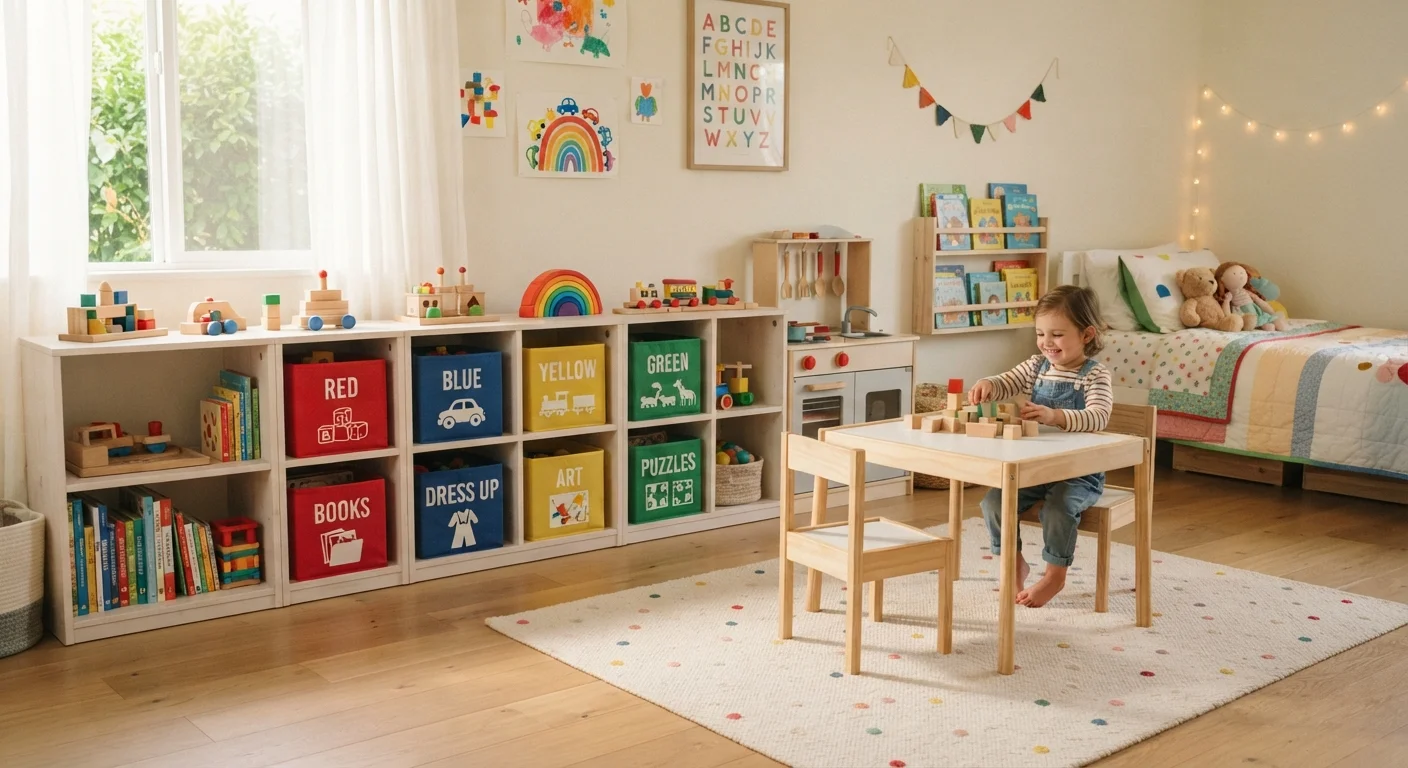
Photo credit: SearchLynk.net | Search Made Easier
In this article
Adult-designed systems often fail in kids' rooms because they don't match how children think. Here's how to set up storage that kids can genuinely keep up with.
Key Takeaways
- Children maintain systems best when storage is at their height and requires minimal steps to use.
- Visual cues like picture labels outperform written labels for younger kids who aren't yet fluent readers.
- Involving children in designing their own systems dramatically increases how long they stick with them.
- Fewer, broader categories work better for kids than highly specific, adult-style organization.
- Regular, low-pressure editing sessions prevent the slow buildup of clutter that overwhelms any system.
Why Adult-Designed Systems Break Down in Kids' Rooms
Walk into most children's rooms a week after a thorough tidy and the clutter is often back. This is rarely about a child being careless - it's about a mismatch between how the system was designed and how kids actually think and move. Adults organize by category, label by function, and plan for long-term maintenance. Children organize by urgency: they want to get the toy out fast and put it away with equal speed.
When a system requires opening lids, reading fine print, or sorting into twelve specific bins, it creates friction that children simply won't navigate after a long day of play. The fix isn't stricter rules - it's smarter design. For a broader look at how conflicting habits affect shared household spaces, see our guide to organizing a home when everyone has different habits.
Best Practices for Building Systems Kids Can Maintain
The following practices are grounded in child development principles and practical home organization. Apply them together for the best results.
Design storage at the child's physical level, not the adult's.
Children won't reliably use shelves they can't reach without climbing or asking for help. Every extra step between a child and their storage is a reason the item ends up on the floor instead. Low shelving, floor-level bins, and hooks at shoulder height for a child remove those barriers entirely.
Use broad categories instead of hyper-specific ones.
Adults can distinguish between 'small LEGO pieces,' 'LEGO minifigures,' and 'LEGO instruction booklets' - but expecting a child to make those calls under time pressure usually results in everything getting dumped together anyway. Fewer, wider categories ('building toys,' 'art supplies,' 'stuffed animals') lower the decision-making burden dramatically.
Replace or supplement written labels with picture labels for younger children.
A child who isn't yet a confident reader can't use written labels reliably, which turns the system into guesswork. Simple drawings, printed photos of the bin's contents, or icon stickers let even preschool-age kids navigate their storage independently.
Eliminate lids wherever possible.
Lidded containers are excellent for adults who open storage infrequently. For children who access toys multiple times a day, lids become the single biggest friction point in any system. Open bins, baskets, and cubbies allow kids to toss items in without slowing down.
Involve children in designing their own system.
A system a child helped create is one they feel responsible for. When kids choose the colors of bins, decide which shelf holds which toys, or draw their own labels, they develop a sense of agency over their space. That ownership translates directly into maintenance behavior.
Build a visible 'home' for everything that matters most.
Items without a designated place always end up as clutter. For frequently used items - a favorite stuffed animal, a bedtime book, a homework folder - a clearly defined, always-available spot removes the mental overhead of deciding where something goes each time.
Quick Wins You Can Put in Place Today
You don't need to overhaul the entire room to start seeing improvement. A few targeted changes can make an immediate difference in whether kids actually use - and reuse - their storage.
Make the Reset Routine Brief and Consistent
A daily 10-minute tidy - done at the same time each day, such as before dinner or as part of a bedtime wind-down - is far more effective than sporadic marathon cleanups. Consistency builds the habit, and keeping it short prevents resistance. For ideas on pairing tidy-up time with an evening routine, see our wind-down routine guide.
Keeping the System Working Over Time
Even well-designed systems need occasional resets. Children grow quickly - the storage that worked at age five may feel babyish or simply insufficient at age eight. Build in a light seasonal review, perhaps twice a year, to swap out storage that no longer fits the child's interests or physical reach.
Involve the child in these reviews rather than doing it while they're at school. When they participate in decisions about what stays, what leaves, and how things are arranged, they develop a sense of ownership that passive organization never creates.
Systems Should Evolve as Children Do
What works for a toddler - floor-level bins with picture labels - won't suit a ten-year-old, who may want more privacy and more nuanced organization. Treat the system as a living structure, not a one-time setup. A brief check-in twice a year to ask 'Is this still working for you?' keeps the system aligned with the child's current life.
For a structured approach to assessing what's working across your whole home, the room-by-room home organization audit offers a useful framework. And if you're navigating tight square footage alongside all of this, storage strategies for compact spaces can help you make every inch count.

Author
Home & Garden Editorial Team
Home & Garden Editorial Team is the collective byline for our editorial team and contributor network. Articles published under this byline or an editorial pen name are researched, written, and reviewed according to our editorial standards for clarity, consistency, and independence before publication.
View all articles →