
Debt Avalanche vs. Debt Snowball: Two Payoff Strategies Compared
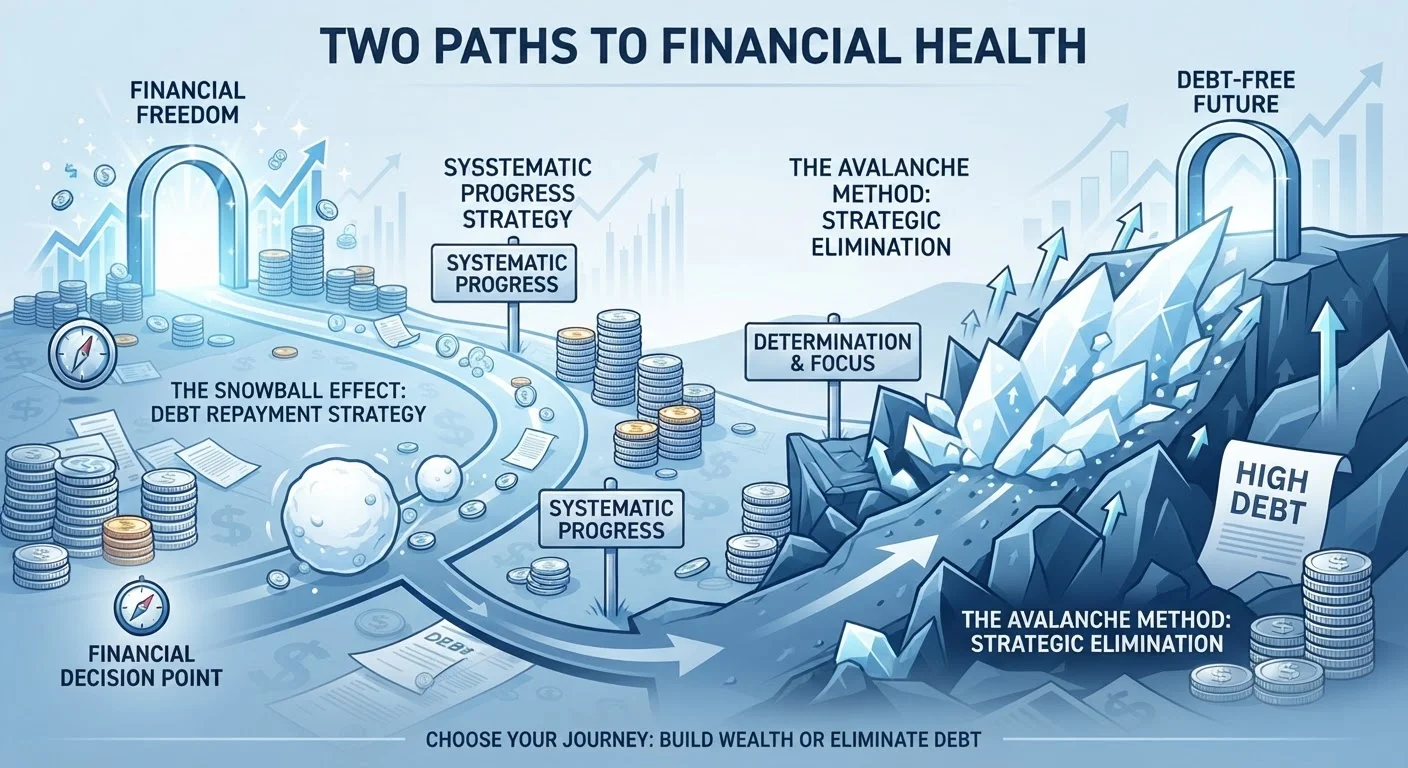
Photo credit: SearchLynk.net | Search Made Easier
The avalanche minimizes interest; the snowball builds momentum. See how each method works and which fits your situation.
Key Takeaways
- The debt avalanche targets high-interest balances first, reducing the total interest you pay over time.
- The debt snowball targets smallest balances first, delivering early wins that can sustain motivation.
- Neither method requires more money - both work with the same monthly payment budget.
- Research suggests the snowball method may improve follow-through for some borrowers despite costing more in interest.
- The best strategy is the one you will stick with consistently over time.
How Each Strategy Works
Both the debt avalanche and the debt snowball follow the same foundational mechanic: you make minimum payments on all your debts, then direct any extra money toward one target account each month. The difference lies entirely in how you choose that target account.
With the debt avalanche, you rank your debts by interest rate - highest to lowest - and focus extra payments on the highest-rate balance first. Once that balance reaches zero, you roll its payment into the next-highest-rate account, and so on. Because you're neutralizing the most expensive debt first, less interest accumulates across your entire portfolio over time.
With the debt snowball, you rank debts by balance - smallest to largest - and target the smallest balance first, regardless of its interest rate. Each time a balance hits zero, you redirect that payment to the next smallest. The growing payment applied to each successive account is the "snowball" rolling downhill.
Understanding which type of debt you're working with matters, too. See how good debt differs from bad debt to better assess which balances deserve the most urgency in your repayment plan.
| Criterion | Debt Avalanche | Debt Snowball |
|---|---|---|
| Payoff order | Highest interest rate first | Smallest balance first |
| Total interest paid | Lower (mathematically optimal) | Higher (rate ignored in ordering) |
| Time to first zero balance | Potentially longer | Faster (smallest gone first) |
| Motivational structure | Long-term, discipline-driven | Short-term wins, momentum-driven |
| Best suited for | Analytical, disciplined borrowers | Motivation-focused borrowers |
| Complexity | Requires tracking interest rates | Simple balance ranking |
The Math vs. The Psychology
On paper, the avalanche wins every time. Because interest compounds on outstanding balances, eliminating the highest-rate debt first reduces how much new interest is generated month after month. Over a multi-year repayment timeline, this difference can add up to a meaningful amount - though the exact figure depends entirely on your individual balances and rates.
The snowball's case isn't mathematical - it's behavioral. Research in consumer psychology has found that people are more likely to continue a repayment plan when they experience early signs of progress. Eliminating a balance entirely - even a small one - provides a concrete sense of achievement that a partial reduction of a large balance does not. For many borrowers, that emotional feedback is what separates a plan they follow through with from one they abandon.
~$1,000+
Potential interest savings with the avalanche method
The exact savings depend on individual balances and rates, but high-rate credit card debt left unaddressed can compound significantly over multi-year repayment timelines.
80%
of Americans carry some form of debt
According to Federal Reserve data, the vast majority of U.S. households hold at least one form of debt, from credit cards to student loans and auto financing.
20%+
Average APR on credit card accounts assessed interest
Federal Reserve consumer credit data shows average credit card interest rates have risen sharply in recent years, making high-rate payoff strategies especially consequential.
The practical implication: if the avalanche would require you to wait 18 months before eliminating a single account, but the snowball would let you close two accounts in the first six months, the snowball may keep you in the game longer - even if it costs more in interest. For strategies that help you build a sustainable plan, explore principles behind sustainable debt repayment.
Choosing the Right Method for You
There is no universally correct answer between these two strategies - the right choice depends on your financial profile and how you respond to financial pressure. A few questions can guide the decision:
- How large is the interest-rate gap between your debts? If one debt carries a 24% APR and others sit near 6%, the cost of ignoring the high-rate balance is steep. The avalanche is likely the stronger choice.
- How many accounts do you carry? A borrower with six small balances may benefit more from the clarity and momentum the snowball provides than from marginal interest savings.
- What's your history with debt repayment? If you've started and stopped plans before, the snowball's early wins may be the accountability structure you need.
Some borrowers use a hybrid approach - applying the snowball to a couple of small balances first to build momentum, then switching to the avalanche for remaining high-rate debts. This isn't a formally defined method, but it can be practical.
Before committing to either approach, it's also worth asking whether your current budget can support consistent extra payments. See how to build a budget around debt repayment for a structured starting point. And if debt consolidation has crossed your mind, understand how it works and when it makes sense before making that move.
What About Balance Transfers or Consolidation?
Both the avalanche and snowball assume your interest rates stay fixed throughout repayment. If you're considering a balance transfer or debt consolidation loan to lower your rates before applying either method, the math changes. A lower rate could make either strategy more effective - but consolidation carries its own trade-offs. Review how debt consolidation works before combining it with a payoff strategy.
This article is for general informational and educational purposes only and does not constitute personalized financial or legal advice. Consult a qualified financial professional for guidance specific to your situation.

Author
Finance Editorial Team
Finance Editorial Team is the collective byline for our editorial team and contributor network. Articles published under this byline or an editorial pen name are researched, written, and reviewed according to our editorial standards for clarity, consistency, and independence before publication.
View all articles →