
The Hidden Costs of Investing: Fees, Taxes, and Inflation Explained
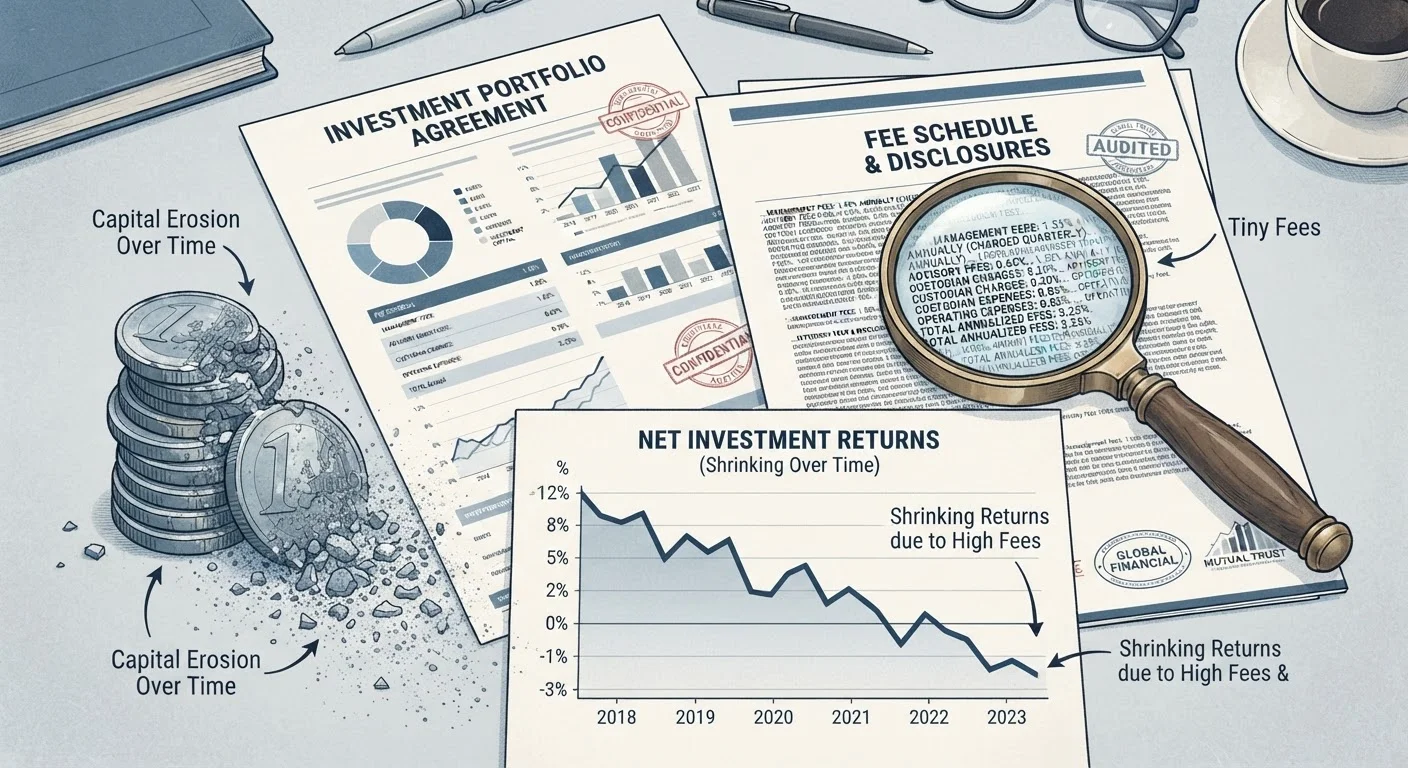
Photo credit: SearchLynk.net | Search Made Easier
In this article
Returns aren't the whole story. Understand how expense ratios, capital gains taxes, and inflation can quietly erode investment growth over time.
Key Takeaways
- Fund expense ratios compound over time and can significantly reduce long-term portfolio value.
- Capital gains taxes differ depending on how long you hold an investment before selling.
- Inflation reduces the purchasing power of returns even when a portfolio shows nominal gains.
- Tax-advantaged accounts like IRAs and 401(k)s can help shelter returns from immediate taxation.
- Comparing funds by expense ratio is one of the most straightforward ways to lower investing costs.
- Real return - what remains after fees, taxes, and inflation - is the number that truly matters.
Why Returns Aren't the Whole Story
New investors tend to focus on one number: the return. Did the fund go up 8% this year? That figure feels like a clear measure of success. But what actually reaches your pocket is shaped by at least three other forces - fees charged by fund managers, taxes owed to the government, and the silent erosion of inflation.
Think of it this way: if your investment earns 7% but you pay a 1% annual expense ratio, lose another 1.5% to taxes on gains, and inflation runs at 2.5%, your real gain is closer to 2%. Understanding this gap is foundational to making sense of long-term investing. As our related guide on risk and return explains, every investing decision involves trade-offs - and costs are one of the most overlooked of them.
1%
Annual fee difference on a 30-year portfolio
Research from Vanguard and others has illustrated that a 1% annual fee differential can reduce final portfolio value by roughly 20% over a 30-year horizon, assuming consistent compounding.
37%
Maximum short-term capital gains tax rate
Under current U.S. federal tax law, short-term capital gains on assets held one year or less are taxed as ordinary income, with the top marginal rate reaching 37% for higher-income filers.
~2-3%
Average annual U.S. inflation (long-run historical)
The Federal Reserve targets 2% annual inflation as a long-run goal; the actual historical average in the U.S. has generally hovered in the 2-3% range over multi-decade periods, per Bureau of Labor Statistics data.
Investment Fees: Small Percentages, Large Consequences
The most common fee investors encounter is the expense ratio - an annual charge expressed as a percentage of your assets that covers a fund's operating costs. A fund with a 0.05% expense ratio costs $5 per year on a $10,000 investment. A fund charging 1.0% costs $100 on the same balance.
That gap seems manageable in year one. But because the fee is deducted from the assets that would otherwise compound, the long-term difference is striking. Over 30 years, the higher-cost fund can claim tens of thousands of dollars in potential growth from a modest starting balance.
Some funds also charge sales commissions (called loads) when you buy or sell shares, or transaction fees imposed by brokerage platforms. The key habit: read the fee disclosures - formally called a fund prospectus - before investing. Our article comparing index funds and actively managed funds covers how cost structures differ between passive and active strategies.
Check the Expense Ratio Before You Invest
Before adding any fund to your portfolio, look up its expense ratio in the fund's prospectus or on the fund company's website. Even a fraction of a percent adds up meaningfully over decades. Many broad-market index funds offer expense ratios well below 0.10%, making them a low-cost baseline for comparison.
Capital Gains Taxes: When Selling Has a Price
When you sell an investment for more than you paid, the profit is called a capital gain, and the IRS generally expects a share. The rate you pay depends largely on how long you held the asset.
- Short-term capital gains apply to assets held one year or less. These are taxed at your ordinary income tax rate, which can be as high as 37% for higher earners.
- Long-term capital gains apply to assets held longer than one year. Rates are generally 0%, 15%, or 20%, depending on your taxable income.
This distinction is one reason investors often think carefully before selling. Holding an investment just past the one-year mark can meaningfully change the tax outcome. Dividend income from stocks or funds is also typically taxable in the year it's received, either as ordinary income or at the lower qualified dividend rate.
Tax-advantaged accounts - such as a traditional 401(k), traditional IRA, or Roth IRA - can defer or reduce these obligations. Contributions to traditional accounts lower taxable income now; Roth accounts allow tax-free growth and withdrawals in retirement. A licensed financial or tax professional can help evaluate which approach fits your circumstances.
Beginners sometimes overlook these dynamics entirely. For a broader look at reasoning errors common early on, see our piece on early investing missteps.
Inflation: The Cost That Never Stops
Inflation is the gradual rise in the general price of goods and services over time. For investors, it functions as a hidden cost that operates continuously - even when markets are performing well.
Consider a portfolio that earns a nominal 5% return in a year when inflation is 3%. The real return - the actual increase in purchasing power - is approximately 2%. Your account balance is higher in dollar terms, but each of those dollars buys less than it did 12 months ago.
This is why holding large amounts of cash in low-interest accounts carries its own risk over long periods: the dollars retain their face value but lose real value each year inflation runs above the interest earned. Investors typically account for inflation by seeking returns that meaningfully exceed it, accepting some degree of market risk to do so.
Understanding how compound interest builds wealth over time also helps frame why inflation is such a serious drag - it compounds in reverse, working against the same mechanism that helps portfolios grow.
Putting It Together: Focusing on Real Returns
The practical takeaway is straightforward: when evaluating any investment, look beyond the headline return. Ask what the expense ratio is, how any gains will be taxed, and whether the return meaningfully outpaces inflation.
Strategies that can help reduce the drag of these costs include: choosing low-expense-ratio funds, using tax-advantaged accounts where eligible, being mindful of holding periods before selling, and maintaining a long-term perspective that accounts for inflation in goal-setting.
Approaches like dollar-cost averaging can also help reduce timing-related tax complexity by spreading purchases and sales across time rather than concentrating them.
This article is for general informational and educational purposes only and does not constitute personalized financial, tax, or investment advice. Readers should consult a qualified financial adviser, tax professional, or attorney regarding decisions specific to their own circumstances.
Frequently Asked Questions

Author
Finance Editorial Team
Finance Editorial Team is the collective byline for our editorial team and contributor network. Articles published under this byline or an editorial pen name are researched, written, and reviewed according to our editorial standards for clarity, consistency, and independence before publication.
View all articles →