
Dollar-Cost Averaging: A Disciplined Way to Invest Over Time
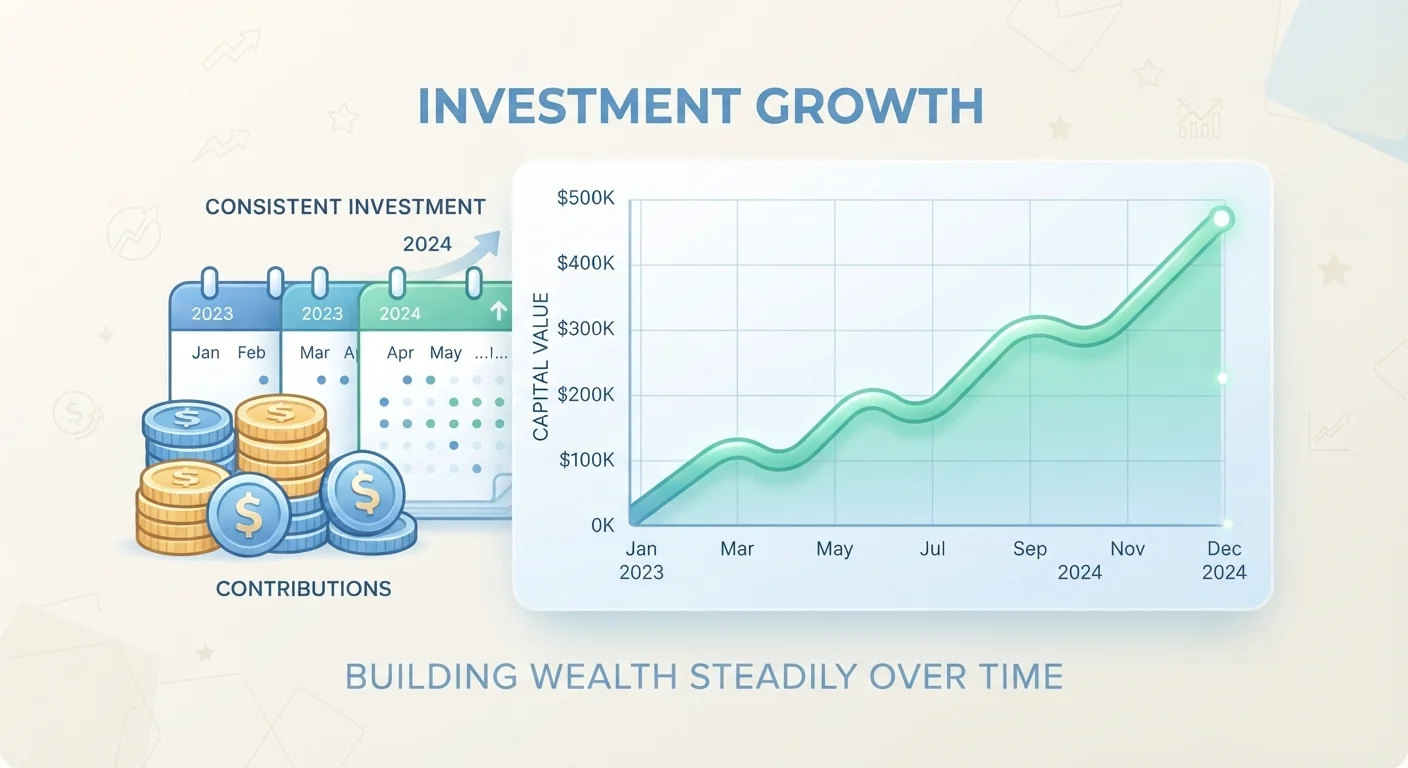
Photo credit: SearchLynk.net | Search Made Easier
In this article
Dollar-cost averaging removes the pressure of market timing. Here's how the strategy works and what it looks like in practice.
Key Takeaways
- Dollar-cost averaging invests a fixed amount on a set schedule, removing the need to time the market.
- The strategy automatically buys more shares when prices fall and fewer when prices rise.
- DCA is particularly useful for investors who are new to markets or prone to emotional decision-making.
- Consistent investing, even in small amounts, benefits from the power of compounding over time.
- DCA does not eliminate risk - all investing involves the potential for loss.
The Problem DCA Solves
One of the most common barriers to investing is the fear of getting the timing wrong. Many people hold off waiting for the "right" moment - a dip in the market, a period of stability, a clearer economic picture. In practice, that moment rarely arrives on schedule, and waiting often means missing out on growth entirely.
Dollar-cost averaging sidesteps this problem by making timing irrelevant. Instead of trying to predict market movements, you invest a set dollar amount on a fixed schedule and let the market do what it does. The strategy removes the need for guesswork and, just as importantly, removes the emotional friction that often derails new investors.
For investors learning to build lasting financial habits, DCA pairs naturally with the kind of consistency discussed in long-term budgeting habits - the same principle of small, regular actions compounding into meaningful results over time.
DCA Is a Strategy, Not a Product
Dollar-cost averaging is an approach to how and when you invest - it is not a specific account, fund, or financial product. It can be applied to a wide range of investment vehicles, from retirement accounts to taxable brokerage accounts. The strategy's effectiveness depends on what you invest in, not just how often you invest.
How the Math Works
The mechanics of DCA are straightforward. Suppose you invest $200 every month into an index fund. Some months the fund's share price is $20, so you acquire 10 shares. Other months the price drops to $10, so you acquire 20 shares. In a rising month at $25, you get 8 shares. Your average cost per share across those three months is lower than if you had bought all shares at the highest price.
This is the averaging effect. Because you are spending a fixed dollar amount rather than buying a fixed number of shares, you naturally accumulate more units when prices are depressed and fewer when prices are elevated. It does not guarantee a profit - if the investment declines and never recovers, losses are still possible - but it does reduce the risk of a poorly timed large purchase.
DCA also interacts constructively with compound interest. The earlier and more consistently you invest, the more time each contribution has to grow - which is why the strategy rewards patience above all else.
~56%
U.S. adults who own stocks
According to Gallup's annual Economy and Personal Finance survey, roughly 56% of American adults report owning stocks, often through retirement accounts that use automatic, recurring contributions.
$7,000
Annual IRA contribution limit (2024)
The IRS sets annual limits on IRA contributions; many savers use monthly contributions to reach this cap gradually - a natural DCA approach.
20+ years
Typical long-term investing horizon for DCA
Financial educators generally emphasize that disciplined, long-horizon strategies like DCA are most effective when maintained over decades rather than months.
What DCA Looks Like in Practice
In the real world, most investors already practice a form of dollar-cost averaging without naming it. Contributing a fixed percentage of each paycheck to a 401(k) is a textbook DCA strategy - the money goes in automatically, at regular intervals, regardless of where the market stands that day.
Outside of workplace retirement plans, investors can apply DCA manually or through automatic investment features offered by many brokerage platforms. Setting up a recurring transfer removes the need for any active decision-making month to month, which is exactly the point.
It is worth understanding how fees factor into any investing approach. Transaction costs, fund expense ratios, and tax implications can affect your real returns over time. Our overview of the hidden costs of investing explains what to watch for.
Common Misconceptions and Limitations
DCA is sometimes described as a guaranteed path to wealth, which overstates its benefits. The strategy manages the risk of mistiming a large purchase - it does not protect against prolonged market declines or guarantee any level of return. All investing carries risk, and investors should only contribute money they do not need in the short term.
Another misconception is that DCA requires a large income or a sizable starting balance. Neither is true. The strategy is designed for consistency, not scale. Even modest regular contributions, maintained over years, can accumulate meaningfully - a point illustrated by the math of compounding growth.
New investors sometimes make the mistake of abandoning a DCA plan during a market downturn, which defeats the purpose of the strategy. Understanding the common thinking patterns behind early investing missteps can help you anticipate and resist that impulse.
This article is for general informational and educational purposes only. It does not constitute personalised financial, investment, or tax advice. Past investment performance does not guarantee future results. Please consult a licensed financial adviser before making decisions about your own circumstances.
Frequently Asked Questions

Author
Finance Editorial Team
Finance Editorial Team is the collective byline for our editorial team and contributor network. Articles published under this byline or an editorial pen name are researched, written, and reviewed according to our editorial standards for clarity, consistency, and independence before publication.
View all articles →