
Compound Interest: The Math Behind Long-Term Wealth Building
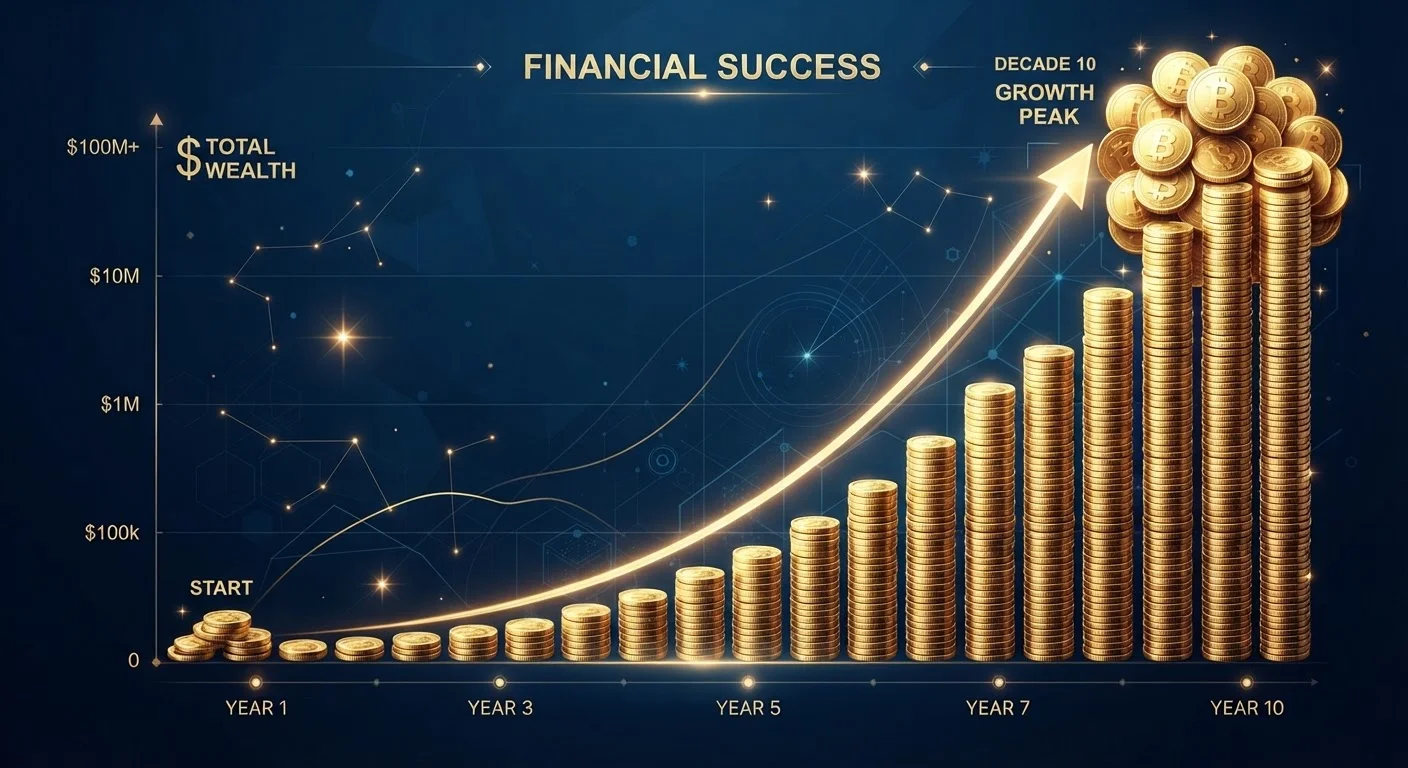
Photo credit: SearchLynk.net | Search Made Easier
In this article
Understand how compound interest works, why time matters so much, and what the numbers actually look like over decades of growth.
Key Takeaways
- Compound interest generates returns on both your original principal and previously earned interest.
- Time is the most powerful variable - starting earlier matters more than investing larger amounts later.
- Compounding works against you on debt, growing balances the same way it grows savings.
- Fees and inflation can meaningfully offset compounding gains over long periods.
- Even modest, consistent contributions compound into substantial sums over decades.
Why "Interest on Interest" Changes Everything
Most people understand that saving money earns interest. What's less intuitive is what happens when that interest stays in the account and begins earning interest of its own. This is the core mechanic of compounding - and it's the reason time in the market matters so much more than many new investors realize.
Consider two savers. One invests $5,000 at age 25 and never adds another dollar. Another invests $5,000 at age 40 under identical conditions. Assuming a consistent hypothetical annual return, the first saver benefits from 15 additional years of compounding. By retirement age, that head start can translate into a balance several times larger - not because of additional contributions, but purely because of time.
This is why financial educators consistently emphasize starting early. The math isn't magic; it's exponential growth applied patiently. The curve starts shallow and eventually bends sharply upward. Most of the growth happens in the later years, which only become available to investors who stayed in long enough to reach them.
“Compound interest is the eighth wonder of the world. He who understands it, earns it; he who doesn't, pays it.”
— Albert Einstein, Widely attributed quote, origin debated by historians - commonly cited in financial education contexts
Breaking Down the Numbers
To make this concrete, consider a hypothetical $10,000 principal earning a consistent 6% annual return, compounded annually. After 10 years, the balance grows to roughly $17,908. After 20 years, it reaches approximately $32,071. After 30 years, it reaches around $57,435. The original $10,000 didn't change - only time did.
$57,435
Hypothetical value of $10,000 after 30 years at 6%
Calculated using standard compound interest formula at 6% annual rate, compounded annually - illustrative only, not a guaranteed return.
~12 years
Time to double money at 6% (Rule of 72)
The Rule of 72 divides 72 by the annual return rate to estimate doubling time - a widely used approximation in financial education.
3x+
Additional growth from 30 vs. 20 years of compounding
Hypothetical $10,000 at 6% grows to ~$32,000 after 20 years and ~$57,000 after 30 years - illustrating the acceleration in the final decade.
Notice that the growth in the final 10-year stretch is larger than the growth in the first 20 years combined. This acceleration is the defining characteristic of compounding. It is slow early and dramatic late, which is why patience is not just a virtue here - it's a mathematical requirement for realizing the full effect.
The formula A = P(1 + r/n)^(nt) captures this precisely. Increasing t (time) has an outsized effect because it sits in the exponent. A small increase in time produces a proportionally large increase in the final balance. This is fundamentally different from adding more money, which scales linearly.
Compounding Works Both Ways
The same mathematical engine that builds wealth can just as efficiently build debt. Credit cards often compound interest daily on unpaid balances. A $3,000 balance at a 22% annual percentage rate, left unpaid, doesn't simply grow by $660 per year in simple interest - it compounds, meaning each day's interest is added to the balance before the next day's calculation.
Understanding this asymmetry is practical, not abstract. The habits that support long-term compounding on savings - consistency, time, avoiding early withdrawals - are the same habits that prevent compounding from working against you on liabilities. Paying down high-interest debt can be thought of as earning a guaranteed return equal to that debt's interest rate. Our coverage of saving and debt strategies explores this balance in more detail.
Track the Real Cost of High-Interest Debt
Before focusing on growing investments, consider whether high-interest debt is compounding faster than any potential returns. Paying off a 20% APR credit card balance is mathematically equivalent to earning a 20% guaranteed return - something no investment can promise. Addressing costly debt and building savings are often pursued in parallel, depending on individual circumstances.
Fees also compound negatively. Investment expense ratios that seem small - 0.5% versus 1.5% annually - reduce the balance that compounds each year. Over 30 years, this gap can cost tens of thousands of dollars in foregone growth. For a fuller picture, see how fees, taxes, and inflation affect returns.
Putting Compounding to Work Practically
Compounding is not limited to large lump sums. Regular contributions amplify the effect. Each new deposit starts its own compounding cycle, layering additional growth potential on top of previous balances. A pattern of consistent monthly contributions - even modest ones - can produce outcomes that dwarf irregular larger contributions made later in life.
Establishing disciplined saving habits early is foundational. Budgeting habits that hold up over the long term create the surplus needed to invest consistently. From there, strategies like dollar-cost averaging complement compounding by removing the pressure of timing the market.
For those ready to apply these principles in practice, building your first investment portfolio offers a structured starting point. Understanding compound interest is not just a mathematical exercise - it's the conceptual foundation for nearly every long-term wealth-building strategy that financial educators recommend.
This article is for general informational and educational purposes only and does not constitute personalized financial, investment, or tax advice. Consult a qualified financial professional before making decisions about your own financial situation. All growth examples are hypothetical and do not guarantee future results.
Frequently Asked Questions

Author
Finance Editorial Team
Finance Editorial Team is the collective byline for our editorial team and contributor network. Articles published under this byline or an editorial pen name are researched, written, and reviewed according to our editorial standards for clarity, consistency, and independence before publication.
View all articles →