
Index Funds vs. Actively Managed Funds
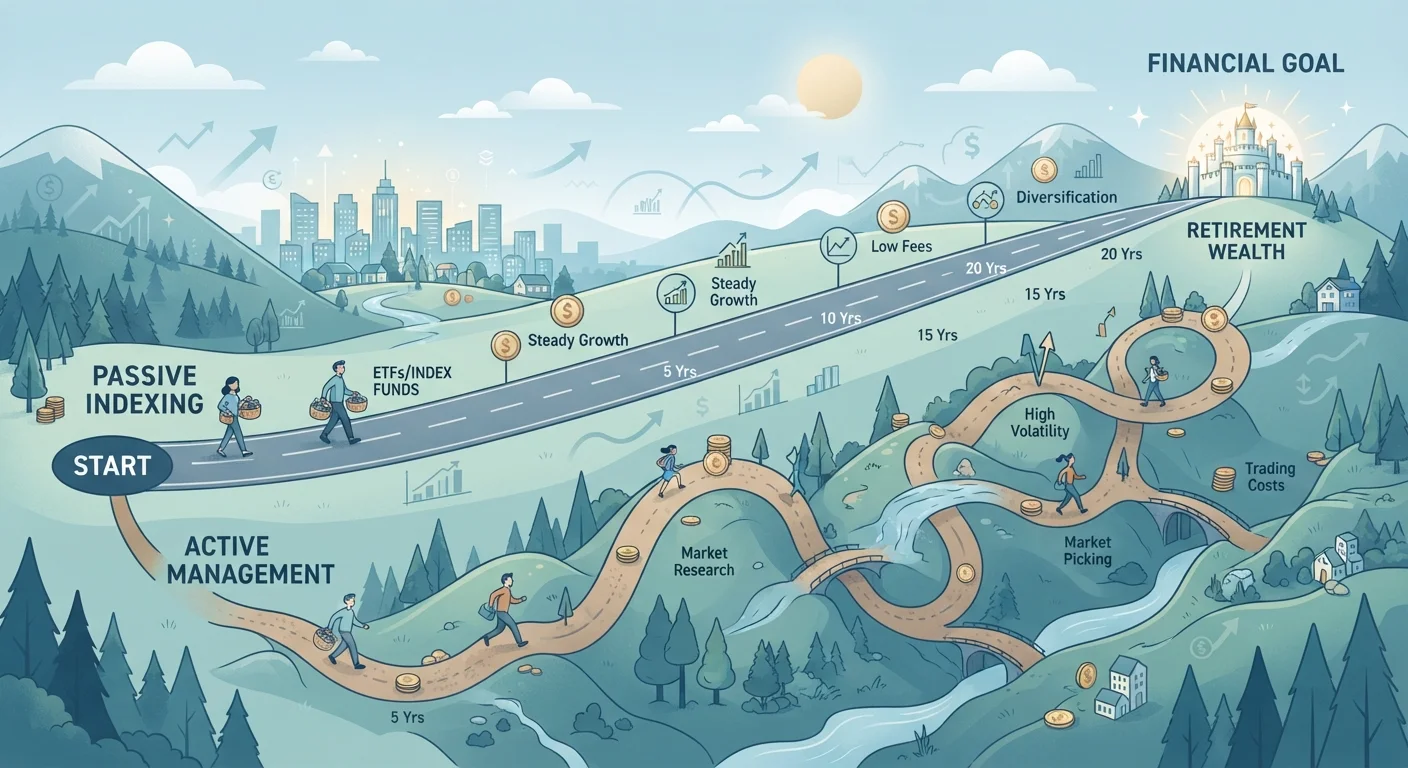
Photo credit: SearchLynk.net | Search Made Easier
In this article
What separates a passive index fund from an actively managed one? See how they differ in cost, strategy, and historical performance patterns.
Key Takeaways
- Index funds track a market benchmark passively; actively managed funds rely on human stock-selection decisions.
- Index funds typically carry significantly lower expense ratios than actively managed funds.
- Research consistently shows most actively managed funds underperform their benchmark index over long periods.
- Neither fund type guarantees returns; both carry investment risk that can result in loss.
- The right choice depends on your financial goals, time horizon, and cost sensitivity.
What Each Fund Type Actually Does
An index fund is designed to mirror the performance of a specific market index - such as the S&P 500, which tracks 500 large U.S. companies. The fund automatically holds the same securities in the same proportions as the index. No manager is deciding which stocks to favor; the portfolio adjusts only when the index itself changes. This passive approach keeps costs low and trading activity minimal.
An actively managed fund, by contrast, employs a portfolio manager - often supported by a team of analysts - who makes deliberate buy and sell decisions in pursuit of returns that exceed a benchmark. The manager's research, judgment, and market outlook drive what the fund holds at any given time.
Before comparing them directly, it helps to understand what mutual funds are as a category. Our article on stocks, bonds, and mutual funds explains the foundational distinctions between core asset classes.
| Criterion | Index Funds | Actively Managed Funds |
|---|---|---|
| Management style | Passive - tracks an index | Active - human stock selection |
| Typical expense ratio | Often under 0.10% | Often 0.50%-1.00% or more |
| Portfolio turnover | Low - changes only with index | Higher - manager-driven trades |
| Potential to beat the market | Matches market, not beats it | Possible, but not guaranteed |
| Tax efficiency | Generally more tax-efficient | Can trigger more taxable events |
| Transparency | Holdings mirror a known index | Holdings vary by manager strategy |
| Long-term performance vs. benchmark | Matches benchmark minus small fees | Most underperform over 10-15 years |
The Cost Difference: Why Fees Matter More Than They Seem
The most concrete difference between index and actively managed funds is cost, measured by the expense ratio - the annual percentage of assets charged to run the fund. Index funds are often available with expense ratios under 0.10%, while many actively managed funds charge 0.50% to 1.00% or more annually.
That gap compounds over time. A higher expense ratio doesn't just reduce a single year's return - it reduces the base on which future growth is calculated. Over decades, the drag from fees can account for a substantial portion of potential wealth. Our related article on the hidden costs of investing walks through exactly how fees, taxes, and inflation erode returns quietly over time.
~85%
Active large-cap funds underperforming S&P 500
According to S&P Dow Jones Indices' SPIVA U.S. Scorecard, roughly 85% of actively managed large-cap U.S. equity funds underperformed the S&P 500 over a 15-year period.
0.05%-1.00%+
Expense ratio range across fund types
Morningstar data indicates a wide spread in annual fund costs, with passive index funds averaging far below actively managed counterparts across major categories.
$10,000+
Estimated fee drag over 20 years on a $10K investment
A 1% annual fee difference can reduce the ending value of a $10,000 investment by more than $10,000 over a 20-year period, assuming consistent market returns - illustrating compounding cost impact.
Actively managed funds also tend to generate more taxable events due to higher portfolio turnover - managers buy and sell more frequently, which can trigger capital gains distributions even in years when the fund's performance is flat.
Performance Patterns: What the Evidence Suggests
A persistent finding in financial research is that most actively managed funds do not outperform their comparable index benchmark over long time horizons - particularly after fees are accounted for. The S&P Indices Versus Active (SPIVA) reports, published by S&P Dow Jones Indices, have consistently shown that a large majority of actively managed U.S. equity funds underperform the S&P 500 over 10- and 15-year periods.
This doesn't mean active management never adds value. Some managers do outperform their benchmarks - the challenge is identifying them in advance, and past outperformance has not proven to be a reliable predictor of future results. Markets in which information is less uniformly available - certain international or small-cap segments - are sometimes cited as areas where active research may have more opportunity to contribute, though the evidence is mixed.
It's important to note that no investment approach guarantees positive returns. Both index funds and actively managed funds can and do lose value, particularly during broad market downturns. The question is not which is risk-free, but which aligns with your goals, cost tolerance, and investment horizon.
How to Think About the Choice
For most everyday investors, the decision often comes down to three factors: cost sensitivity, investment horizon, and desired involvement level. Index funds suit investors who prefer a straightforward, low-maintenance approach and want to keep as much of their return as possible rather than paying for active management that may or may not outperform.
Actively managed funds may be worth considering if you have a specific strategic goal - for instance, exposure to a particular market segment - or if you understand and accept the higher costs in exchange for the possibility of benchmark-beating returns. Either way, this is a decision worth discussing with a licensed financial adviser who can assess your full financial picture.
Also worth noting: index funds are available in both mutual fund and ETF (exchange-traded fund) structures. If you're uncertain how ETFs differ from traditional mutual funds, our explainer on what an ETF is and how it differs from a mutual fund covers the structural distinctions clearly.
This article is for general informational and educational purposes only and does not constitute personalized financial, investment, tax, or legal advice. Past performance of any fund or strategy does not guarantee future results. Please consult a qualified, licensed financial professional before making investment decisions.

Author
Finance Editorial Team
Finance Editorial Team is the collective byline for our editorial team and contributor network. Articles published under this byline or an editorial pen name are researched, written, and reviewed according to our editorial standards for clarity, consistency, and independence before publication.
View all articles →