
What an ETF Is and How It Differs from a Mutual Fund
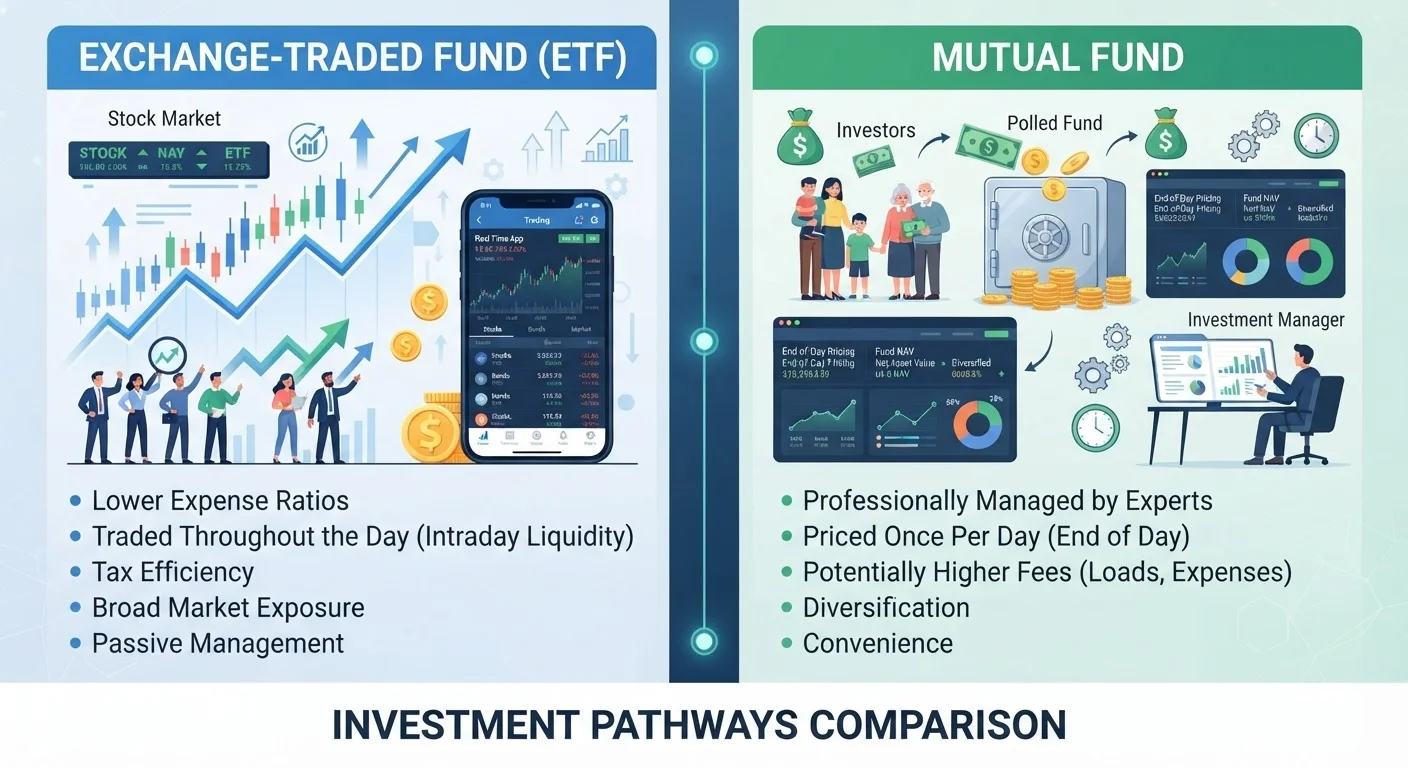
Photo credit: SearchLynk.net | Search Made Easier
In this article
ETFs and mutual funds are often mentioned together but work differently. This explainer walks through the structural distinctions and practical implications.
Key Takeaways
- ETFs trade on stock exchanges throughout the day; mutual funds price once per day after markets close.
- ETFs typically carry lower expense ratios than actively managed mutual funds.
- Mutual funds often allow automatic contributions and fractional investing more readily than ETFs.
- Both ETFs and mutual funds can track indexes or be actively managed - they are structures, not strategies.
- Tax efficiency generally favors ETFs due to their unique share-creation mechanism.
- Neither vehicle guarantees returns; all investing involves risk of loss.
What Is an ETF?
An exchange-traded fund (ETF) is a pooled investment vehicle that holds a collection of assets - such as stocks, bonds, or commodities - and trades on a stock exchange under its own ticker symbol, just like an individual stock. When you buy one share of an ETF, you gain exposure to all the underlying assets it holds in proportion to their weighting in the fund.
Most ETFs are designed to track an index - a predefined list of securities representing a market segment, such as the S&P 500 or the U.S. bond market. However, actively managed ETFs also exist. The defining structural feature of an ETF is not its strategy but how it is bought and sold: on an exchange, at prices that fluctuate throughout the trading day based on supply and demand.
For a broader look at foundational investment types, see our guide to stocks, bonds, and mutual funds.
| Criterion | ETF | Mutual Fund |
|---|---|---|
| How it trades | On an exchange, intraday | Directly with fund, end-of-day |
| Pricing | Real-time market price | Once-daily NAV |
| Typical expense ratio | Generally lower on average | Varies; higher for active funds |
| Tax efficiency | Generally more tax-efficient | Can distribute capital gains broadly |
| Minimum investment | Price of one share (or fractional) | Often $500-$3,000 minimum |
| Auto-investing ease | Growing support at brokerages | Widely supported historically |
| Can be actively managed? | Yes | Yes |
| Can track an index? | Yes | Yes |
What Is a Mutual Fund?
A mutual fund is also a pooled investment vehicle that collects money from many investors and puts it into a portfolio of assets. The key structural difference is how it is priced and transacted. Mutual fund shares are not traded on an exchange. Instead, investors buy and redeem shares directly through the fund company, and the price - called the net asset value (NAV) - is calculated once per day after the markets close.
This end-of-day pricing means you cannot react to intraday market moves the way you can with an ETF. Whether you place your order at 9:30 a.m. or 3:45 p.m., you receive the same closing price. Mutual funds can be passively managed (tracking an index) or actively managed by a portfolio manager making deliberate security selections - often at a higher cost.
$9T+
U.S. ETF assets under management
According to Investment Company Institute data, U.S. ETF assets surpassed $9 trillion, reflecting rapid growth in adoption among retail and institutional investors.
~0.16%
Average ETF expense ratio
ICI figures indicate the asset-weighted average expense ratio for ETFs is substantially below that of actively managed mutual funds, which have averaged closer to 0.6-0.7%.
~8,700
Mutual funds available in the U.S.
The Investment Company Institute reports thousands of mutual funds operating in the U.S., offering strategies spanning every major asset class and risk profile.
Key Structural Differences That Matter to Investors
Understanding the mechanics behind each structure helps explain why the choice between them is more than academic. Here are the most practically significant differences:
- Trading: ETFs trade on exchanges in real time; mutual funds settle once daily at NAV.
- Costs: ETFs generally carry lower average expense ratios, particularly compared to actively managed mutual funds. Passively managed index mutual funds can be comparably priced.
- Tax efficiency: ETFs use a process called in-kind creation and redemption that typically generates fewer taxable capital-gain distributions than mutual funds, which may be required to distribute gains to all shareholders when other investors redeem.
- Minimum investments: Many mutual funds require a minimum initial investment (sometimes $1,000 or more), while ETFs can be purchased for the price of a single share - or less, with fractional share programs at many brokerages.
- Automatic investing: Mutual funds have traditionally been easier to set up for recurring dollar-amount contributions; ETFs are catching up as brokerages add fractional share and auto-invest features.
For clarity on terms like NAV, expense ratio, and capital gains distributions, our glossary of commonly misunderstood financial terms is a useful reference.
Strategy vs. Structure: A Common Source of Confusion
A frequent misconception is that ETFs are passive and mutual funds are active - but that conflates strategy with structure. Both vehicles can be either. An actively managed ETF employs a portfolio manager making daily decisions just as an active mutual fund does. Similarly, index mutual funds passively track benchmarks at costs rivaling ETFs.
The more meaningful comparison for most new investors is between index-based strategies and actively managed strategies - regardless of the wrapper. Our comparison of index funds and actively managed funds explores that distinction in depth.
What the ETF or mutual fund structure itself determines is primarily how you access the investment: when it prices, how you buy and sell it, and how tax events are typically distributed. Both involve real market risk, and neither guarantees a positive return. Consulting a licensed financial adviser before making investment decisions based on your personal circumstances is always a sound step.
This article is for general informational and educational purposes only and does not constitute personalized financial, investment, tax, or legal advice. All investing involves risk, including the potential loss of principal. Past performance does not guarantee future results. Consult a qualified financial professional before making investment decisions.

Author
Finance Editorial Team
Finance Editorial Team is the collective byline for our editorial team and contributor network. Articles published under this byline or an editorial pen name are researched, written, and reviewed according to our editorial standards for clarity, consistency, and independence before publication.
View all articles →