
What Traveling in Italy Actually Involves, Region by Region
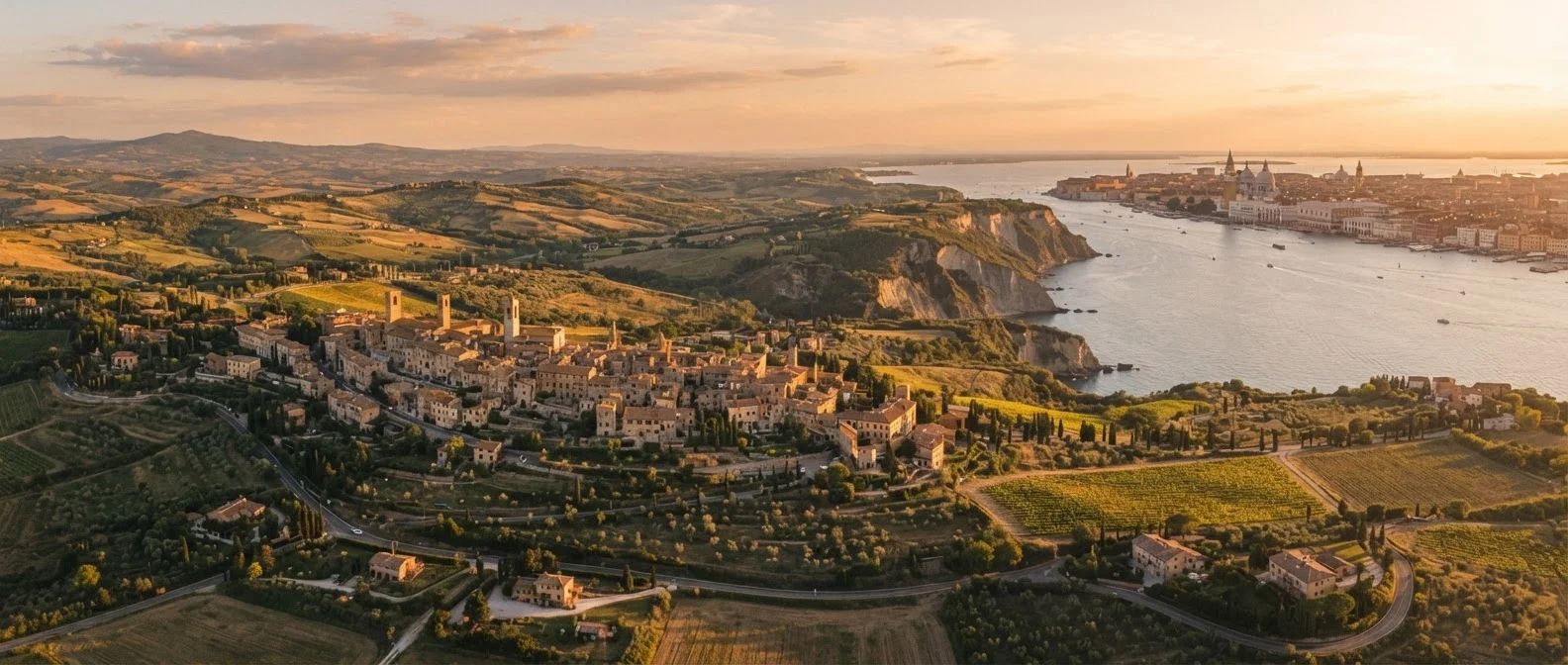
Photo credit: SearchLynk.net | Search Made Easier
In this article
Italy's north, center, and south are culturally and logistically distinct. Understand how Rome, Tuscany, the Amalfi Coast, and Venice differ before you plan.
Key Takeaways
- Italy's north, center, and south differ significantly in infrastructure, pace, and visitor logistics.
- Rome rewards advance booking for major sites; walk-up access to popular monuments is rarely reliable.
- Tuscany is largely car-dependent outside Florence - rural villages are not well served by public transit.
- Venice has no cars; all navigation is by foot or water, and distances can surprise first-time visitors.
- The Amalfi Coast is scenic but logistically challenging, especially in summer when roads are congested.
- Crossing between regions takes planning; high-speed rail connects major cities but rural areas require extra effort.
Why Italy Is Really Several Trips in One
Italy is one of the world's most-visited countries, but treating it as a single destination often leads to frustration. The cultural gap between Milan and Palermo is roughly analogous to the gap between Boston and New Orleans - same country, very different rhythms, expectations, and infrastructure.
What works smoothly in one region may require entirely different strategies in another. Trains that run efficiently in the north become slower and less frequent as you head south. Cities designed around pedestrian life give way to landscapes where a rental car is the only practical option. Understanding these differences before you commit to an itinerary will save you significant stress on the ground.
This guide walks through Italy's key destination zones - not as a ranked list, but as an honest look at what travel in each area actually involves. For a broader framework on building a coherent multi-stop trip, see our trip-planning anatomy guide.
58M+
International visitors to Italy annually
Italy consistently ranks among the world's top five most-visited countries, according to UN Tourism data.
20
Distinct administrative regions in Italy
Each of Italy's 20 regions has its own dialect traditions, cuisine, and varying levels of tourist infrastructure.
90 min
Rome to Florence by high-speed train
High-speed rail has significantly reduced intercity travel times on Italy's main north-south corridor.
Rome: Ancient Scale and Urban Logistics
Rome is a large city with a world-class metro system that, by Roman standards, is still limited. The two main subway lines don't reach many of the most-visited sites - the Colosseum and Vatican are reachable, but much of the historic center requires walking or buses.
The core issue for most visitors isn't transportation - it's crowds and booking. The Colosseum, the Vatican Museums, and the Borghese Gallery all require timed-entry reservations, often weeks or months in advance. Walk-up entry at peak times is either impossible or involves multi-hour queues. First-time visitors who don't book ahead frequently miss the sites they traveled to see.
Rome also asks more physically of visitors than many expect. The city is hilly, the cobblestones are beautiful but demanding, and the distances between major sites are longer than they appear on maps. Budget more time and energy than you think you'll need.
Book major Roman sites - the Colosseum, Vatican Museums, and Borghese Gallery - at least four to six weeks before your trip, especially for summer or holiday travel. Entry slots at peak times can be fully reserved within hours of release.
Walk-up queues at Rome's most popular monuments regularly run two to three hours or longer, and some venues are fully booked online well in advance of busy periods.
When driving in Tuscany, photograph or screenshot the ZTL zone boundaries for each town you plan to visit before you leave - not all rental car GPS units flag restricted zones automatically.
ZTL fines are processed through the vehicle registration and forwarded to the rental agency, which passes the charge plus an administrative fee on to the renter - sometimes months after the trip.
Tuscany: Rural Pace and Getting Around
Tuscany's appeal - hilltop villages, vineyard landscapes, medieval towns - is exactly what makes it logistically tricky. Florence is well-connected by high-speed rail, but the countryside outside it is largely inaccessible without a car.
Towns like Montalcino, Pienza, and San Gimignano have limited or no direct public transit. Buses exist but run infrequently, often once or twice daily, with schedules designed around local commuters rather than tourists. If you want to explore rural Tuscany, a rental car is the practical answer for most travelers.
This also means factoring in narrow roads, limited parking in historic centers (many of which are pedestrian-only or restricted traffic zones - called ZTL areas), and GPS signals that occasionally fail in remote valleys. Enter a ZTL zone without authorization and you may receive a fine by mail weeks after returning home.
Check ZTL Rules Before Driving Into Any Historic Town
Restricted traffic zones (ZTL) exist in most historic Italian town centers and are enforced by cameras without signage obvious to visitors. Before driving to any walled or historic town in Tuscany or elsewhere, verify the zone boundaries and permitted access hours online or with your accommodation. Your hotel or agriturismo host is often the most reliable local source for this information.
Venice: A City That Works on Its Own Terms
Venice requires a genuine mental reset. There are no cars, no bikes, and no shortcuts through the city's maze of calli (narrow streets) and canals. Everything moves by foot or by water - vaporetti (water buses) serve as the public transit system, while water taxis are a faster but more expensive option.
Navigation is more difficult than in any other Italian city. Even with a map or GPS, getting turned around is common, and what looks like a short distance can involve several bridge crossings and dead-ends at canal edges. Build extra time into every journey, especially on your first day.
The city also has a resident population that has been declining for decades, meaning many neighborhoods increasingly cater to tourism rather than functioning as lived-in urban spaces. Visitors who venture beyond the Rialto and San Marco districts into quieter sestieri like Cannaregio or Dorsoduro get a meaningfully different - and often more rewarding - experience. See how slow travel approaches compare to fast-paced itineraries for context on pacing decisions like this.
The Amalfi Coast and Southern Italy
The Amalfi Coast is one of the most photographed places in Italy - and one of the most logistically demanding. The main coastal road is a single two-lane highway carved into cliffs above the sea. In summer, it becomes severely congested, with large buses navigating hairpin turns while cars, scooters, and pedestrians compete for space.
Ferries between coastal towns are often the faster, calmer option in summer, but schedules are weather-dependent. Positano, Ravello, and Amalfi itself are all worth the effort, but visitors expecting an easy, relaxed drive along the coast often find the reality more stressful.
Southern Italy more broadly - including Naples, Puglia, Sicily, and Calabria - tends to be less visited, less expensive, and less scripted for international tourists than the center-north. Infrastructure can be less predictable: trains run but may be delayed; not all accommodations offer English-language support; and some areas have limited ATM access. These are not reasons to avoid the south - many travelers find it the most authentic part of Italy - but they are reasons to plan with more flexibility built in.
For guidance on timing your visit to any Italian region, our guide to peak-season vs. off-season travel offers a useful framework.
Planning Across Regions: Practical Considerations
Connecting Italy's regions requires deliberate planning. High-speed trains (Frecciarossa and Italo services) link Rome, Florence, Venice, Milan, and Naples efficiently - travel times between Rome and Florence run around 90 minutes, Rome to Naples under 70. Regional trains between smaller cities run more slowly and with less frequency.
If your itinerary crosses multiple regions, consider the transition days themselves as part of your trip. A travel day between Venice and the Amalfi Coast is not a short hop - it typically involves a train to Naples plus onward transport, often consuming the better part of a day.
Whether you're traveling independently or joining an organized trip matters here too. Package tours and independent travel each involve real trade-offs in a country as logistically varied as Italy - group tours handle logistics but limit spontaneity, while independent travel offers flexibility at the cost of more planning effort.
Regardless of how you structure your trip, verifying entry requirements, travel advisories, and transportation options through official government and provider sources before you travel is essential. Conditions and schedules change, and no pre-trip research replaces a final check close to your departure date. See the Travel Tips hub for additional guidance on logistics, packing, and on-the-ground navigation.

Author
Travel & Trips Editorial Team
Travel & Trips Editorial Team is the collective byline for our editorial team and contributor network. Articles published under this byline or an editorial pen name are researched, written, and reviewed according to our editorial standards for clarity, consistency, and independence before publication.
View all articles →