
What the Nutrition Facts Label Is Actually Telling You
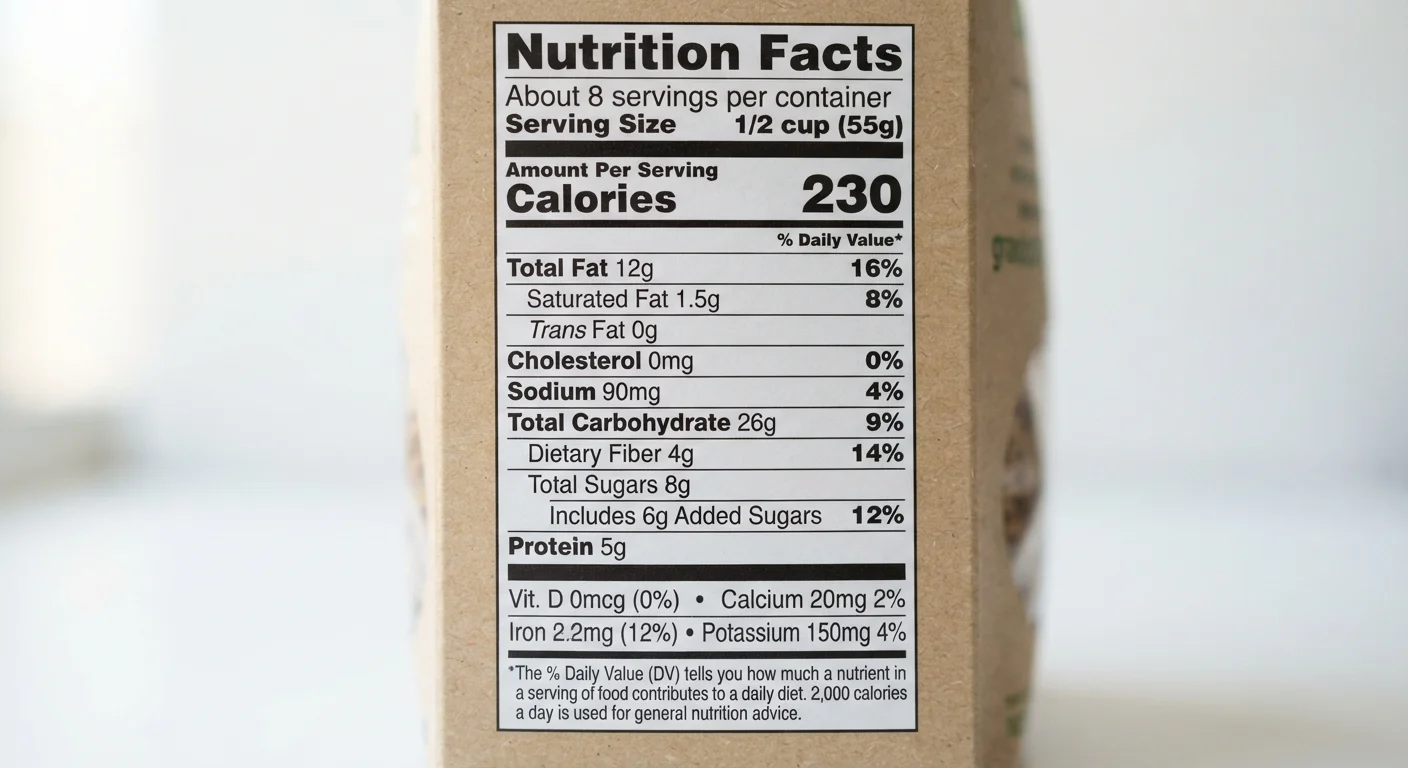
Photo credit: SearchLynk.net | Search Made Easier
In this article
Decode the numbers on packaged food labels — from serving sizes to % Daily Value — and learn what actually matters for everyday eating.
Key Takeaways
- Serving size drives every other number on the label - always check it first.
- % Daily Value shows how much a nutrient in one serving contributes to a 2,000-calorie reference diet.
- 5% DV or less is generally considered low for a nutrient; 20% DV or more is considered high.
- Added sugars and sodium are two nutrients most Americans consume in excess.
- The label reflects one serving, not necessarily the whole package - which is often more than one serving.
- No single nutrient on the label tells the whole story; the overall pattern of eating matters most.
Start Here: Serving Size Is the Foundation
Before any other number on the label makes sense, you need to know the serving size. Every calorie count, gram of fat, and percentage listed on the label applies to one serving - not the entire package.
The FDA bases serving sizes on reference amounts that reflect how much people typically consume at one time, not what is recommended. A bag of chips might list a serving as 1 ounce (about 28 grams), but if you eat the whole bag - which often contains 2.5 servings - you've taken in 2.5 times every number shown.
This is one of the most common sources of confusion. Two otherwise identical-looking products can appear very different nutritionally simply because one uses a smaller serving size. Always compare serving sizes when evaluating two products side by side.
Check Servings Per Container First
Before reading any other part of the label, look at the top line: 'servings per container.' A product that appears moderate in sodium or calories can look very different once you multiply by the actual number of servings in the package. This single habit prevents most label-reading mistakes.
Calories: What They Measure and What They Don't
Calories measure the amount of energy a food provides. The FDA updated the label to display calorie counts in larger, bolder type specifically because calorie awareness helps many people manage their energy intake.
That said, calories are not a complete picture of nutritional quality. A 200-calorie serving of almonds and a 200-calorie serving of a sugary snack cake have very different nutritional profiles - different amounts of protein, fiber, vitamins, and minerals. Calorie counts are a useful starting point, not a final judgment.
Individual calorie needs vary considerably based on age, body size, activity level, and health status. The 2,000-calorie reference used on labels is a general benchmark, not a universal target. For guidance specific to your situation, a registered dietitian or healthcare provider is the right resource.
Understanding % Daily Value
The % Daily Value (% DV) column is one of the label's most useful tools, and also one of the most misunderstood. It tells you what percentage of the recommended daily amount of each nutrient one serving provides - based on a 2,000-calorie reference diet.
The FDA provides a simple rule of thumb: 5% DV or less means a food is a low source of that nutrient; 20% DV or more means it's a high source. Whether high or low is desirable depends on the nutrient:
- Nutrients to limit: saturated fat, sodium, and added sugars. Lower % DV is generally preferable.
- Nutrients to get enough of: dietary fiber, vitamin D, calcium, iron, and potassium. Higher % DV is generally preferable.
To understand more about the roles these nutrients play in the body, see our guide on macronutrients and micronutrients.
The 2,000-Calorie Reference Is a Benchmark, Not a Target
% Daily Values are calculated against a 2,000-calorie reference diet, which the FDA selected as a general population benchmark. Your actual calorie needs may be higher or lower depending on your age, sex, body size, and activity level. Use % DV for quick nutrient comparisons between products, not as a precise personal prescription.
The Nutrients Worth Watching Closely
Sodium is present at surprisingly high levels in many packaged foods - soups, breads, deli meats, and condiments especially. The daily reference value is 2,300 mg, and a single serving of some products can account for a third or more of that total.
Added sugars appear as a separate line beneath total sugars - an FDA requirement since 2020. Natural sugars (those found in whole fruit or plain dairy) behave differently metabolically than sugars added during processing. Most dietary guidance focuses limits on added sugars specifically, not total sugar intake broadly.
Saturated fat and dietary fiber are also worth regular attention. Saturated fat is linked in dietary research to cardiovascular risk factors when consumed in excess, while fiber supports digestive health and is chronically under-consumed by most Americans. You can learn more about fiber's role in our article on dietary fiber and why most Americans fall short. For a deeper look at how different fats compare, see saturated, unsaturated, and trans fats unpacked.
~70%
Americans exceed recommended sodium intake
According to the CDC, most Americans consume more than the 2,300 mg daily sodium reference amount, largely driven by packaged and restaurant foods.
17g
Average daily added sugar intake per American adult
National Health and Nutrition Examination Survey (NHANES) data suggests average added sugar consumption significantly exceeds the American Heart Association's recommended limits for many adults.
<10%
Americans meeting daily fiber recommendations
Research published in the American Journal of Lifestyle Medicine estimated that fewer than 1 in 10 Americans consume adequate dietary fiber each day.
What the Label Doesn't Tell You
The Nutrition Facts label covers a defined set of nutrients - but it doesn't tell you everything about a food's quality. It won't reveal how processed the food is, what the full ingredient list looks like, or how a food fits into your overall dietary pattern. For that, the ingredient list is equally important. Our article on reading and comparing food ingredient lists is a practical next step.
Marketing claims on the front of a package - terms like "natural," "light," or "made with whole grains" - are not regulated as rigorously as the Nutrition Facts panel. The back-of-the-package label is the more reliable source of information. Front-of-package health claims can sometimes mislead, which connects to broader patterns explored in common nutrition myths.
The label is a tool - a useful one - but it works best when you use it consistently and in combination with a broader understanding of what healthy eating actually looks like for you personally. If you have specific health conditions or dietary goals, a registered dietitian can help you interpret label information in the context of your individual needs.
This article is for general informational and educational purposes only and does not constitute medical or dietary advice. Consult a qualified healthcare professional for guidance specific to your health situation.
Frequently Asked Questions

Author
Health & Wellness Editorial Team
Health & Wellness Editorial Team is the collective byline for our editorial team and contributor network. Articles published under this byline or an editorial pen name are researched, written, and reviewed according to our editorial standards for clarity, consistency, and independence before publication.
View all articles →