
Emergency Fund vs. Paying Off Debt: Where Should Your Money Go First?
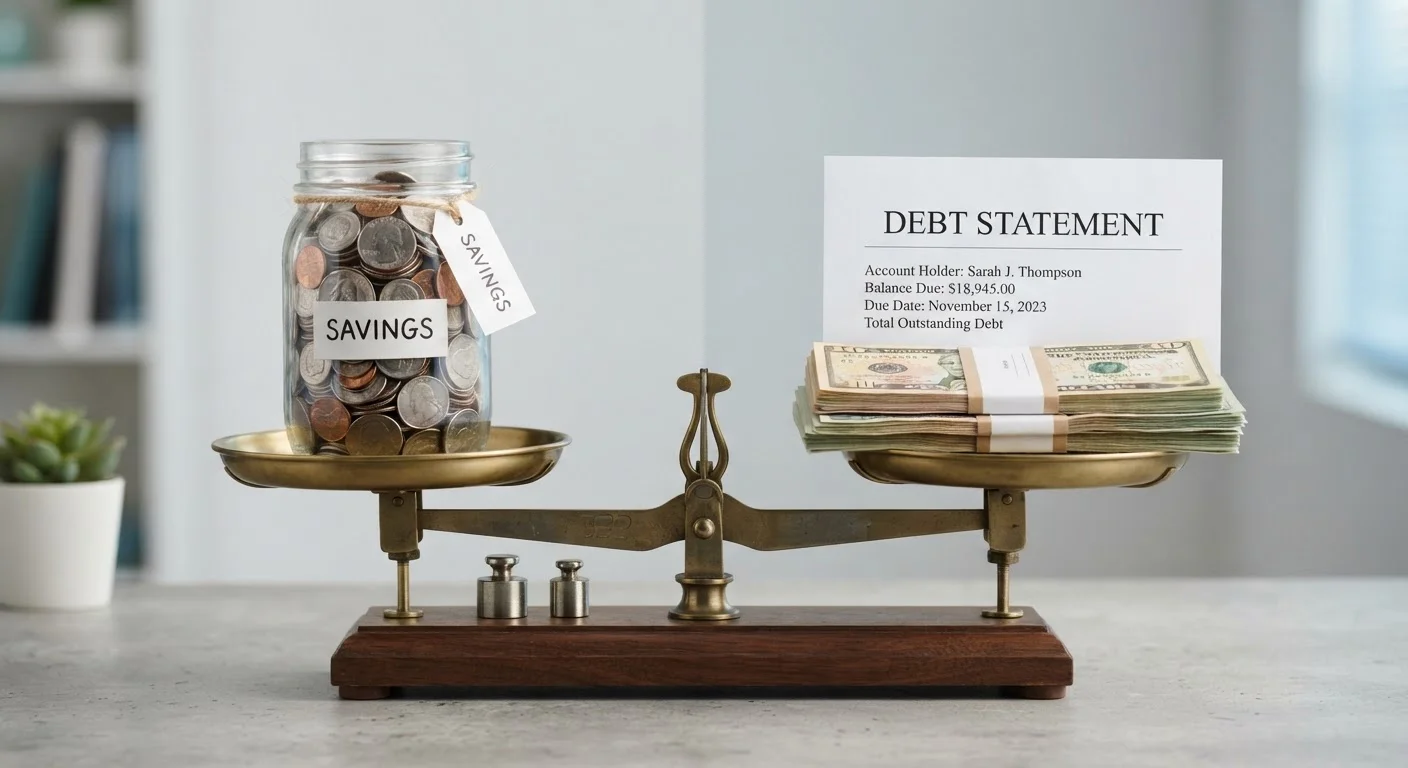
Photo credit: SearchLynk.net | Search Made Easier
In this article
Should you build a financial cushion or tackle what you owe? Here's how to think through the trade-off clearly.
Key Takeaways
- A small starter emergency fund of $500-$1,000 can prevent new debt when unexpected expenses arise.
- High-interest debt, especially above 7-8%, often costs more than a savings account earns.
- Most financial educators suggest doing both simultaneously once a starter fund is in place.
- Your income stability and debt interest rates should guide how you prioritize each goal.
- Neither goal should be ignored entirely - balance matters more than perfection.
Why This Decision Is Harder Than It Looks
On the surface, the math seems to favor paying off debt. If a credit card charges 22% interest annually and a savings account earns 4-5%, every dollar left in savings while the card accrues interest is a net loss. But personal finance rarely operates on math alone.
Without any emergency savings, an unexpected car repair or medical bill can push someone straight back into debt - often at the same high interest rate they were trying to escape. That cycle is one of the most common reasons debt persists. The emergency fund isn't just a savings goal; it's a debt-prevention tool.
The core tension is real: every dollar has one job at a time. Putting it toward debt reduces interest. Putting it toward savings builds security. Understanding how these two goals interact - rather than compete - is what helps people make a choice that actually holds up over time.
Interest Rate Is a Key Factor
The interest rate on your debt is one of the most important variables in this decision. Low-rate debt (such as a federal student loan or mortgage) typically warrants less urgency than high-rate debt like credit cards or payday loans. As a general rule of thumb used in financial education, debt with an interest rate above roughly 7-8% often deserves aggressive repayment priority. This is general guidance, not personalized financial advice - your specific situation matters.
The Case for the Emergency Fund First
Financial educators often recommend building a small emergency fund before aggressively tackling debt. The reasoning: even $500-$1,000 in a liquid account can absorb routine shocks - a flat tire, a vet bill, a short-term income gap - without requiring a credit card swipe.
For households with no savings at all, this starter fund acts as a firewall. It doesn't earn much, but it prevents the debt balance from growing while you work to reduce it. Once that baseline is in place, the calculus shifts.
A full emergency fund - commonly described as three to six months of essential living expenses - becomes a stronger priority when income is variable, job security is uncertain, or dependents rely on the household. In those situations, the cost of not having savings can be far higher than the interest paid on a low- or moderate-rate debt. For guidance on where to park that fund, see how savings accounts, money market accounts, and CDs compare.
The Case for Prioritizing Debt Repayment
When debt carries a high interest rate - particularly credit cards, which commonly run above 20% APR - paying it down delivers a guaranteed, risk-free return equivalent to that rate. No investment reliably beats that on a consistent basis, and past investment performance does not guarantee future results.
The argument for debt-first is strongest when: the interest rate is high, the balance is manageable relative to income, and there's at least a minimal cash buffer already in place. Under those conditions, every additional dollar toward debt eliminates a compounding cost rather than sitting in an account earning a fraction of what it's costing elsewhere.
Once high-interest debt is eliminated, the cash that was going toward payments becomes available for savings, investing, and other financial goals. That momentum is significant. For a structured approach to clearing multiple debts, the debt avalanche and debt snowball methods offer two proven frameworks worth comparing.
| Criterion | Emergency Fund | Paying Off Debt |
|---|---|---|
| Primary benefit | Financial security buffer | Reduces interest costs |
| Best suited for | Low/no savings, unstable income | High-interest debt, stable income |
| Return on money | Modest interest earned | Guaranteed savings = debt interest rate |
| Risk if skipped | New debt from emergencies | Compounding interest grows balance |
| Liquidity | Funds remain accessible | Paid-off debt not retrievable |
| Psychological benefit | Reduces financial anxiety | Builds momentum and reduces burden |
The Middle Path: Doing Both at Once
For many households, the most practical answer isn't either/or - it's a split approach. A common strategy is to build a small emergency fund first ($500-$1,000), then divide extra monthly cash between debt repayment and continued savings growth. This isn't indecision; it's risk management.
The ratio of that split depends on interest rates and personal circumstances. Someone with 24% APR credit card debt might direct 80% of extra funds toward that balance and 20% toward savings. Someone with a 4% auto loan might flip those proportions. There's no universal formula, and this general information is not a substitute for personalized financial advice - a qualified financial professional can help you evaluate your specific situation.
Building your monthly plan around both goals simultaneously requires a clear budget. Structuring your budget around debt repayment can help make both goals a consistent, planned part of your finances rather than a monthly guessing game. And before redirecting freed-up cash to other goals, reviewing a financial readiness checklist is a useful next step.
~57%
Americans who can't cover a $1,000 emergency
Bankrate's annual emergency savings report has consistently found that a majority of U.S. adults lack sufficient liquid savings to absorb an unexpected four-figure expense.
20%+
Average credit card APR in the U.S.
Federal Reserve data shows average credit card interest rates have remained above 20% in recent years, making high-interest debt a significant financial drag.
3-6 months
Recommended emergency fund coverage
Most personal finance frameworks suggest covering three to six months of essential expenses, with the higher end recommended for variable-income or single-earner households.
This article is for general informational and educational purposes only and does not constitute personalized financial, investment, or legal advice. Consult a qualified financial professional before making decisions about your specific financial situation.

Author
Finance Editorial Team
Finance Editorial Team is the collective byline for our editorial team and contributor network. Articles published under this byline or an editorial pen name are researched, written, and reviewed according to our editorial standards for clarity, consistency, and independence before publication.
View all articles →