
How Exchange Rates and Foreign Transaction Fees Quietly Drain a Travel Budget
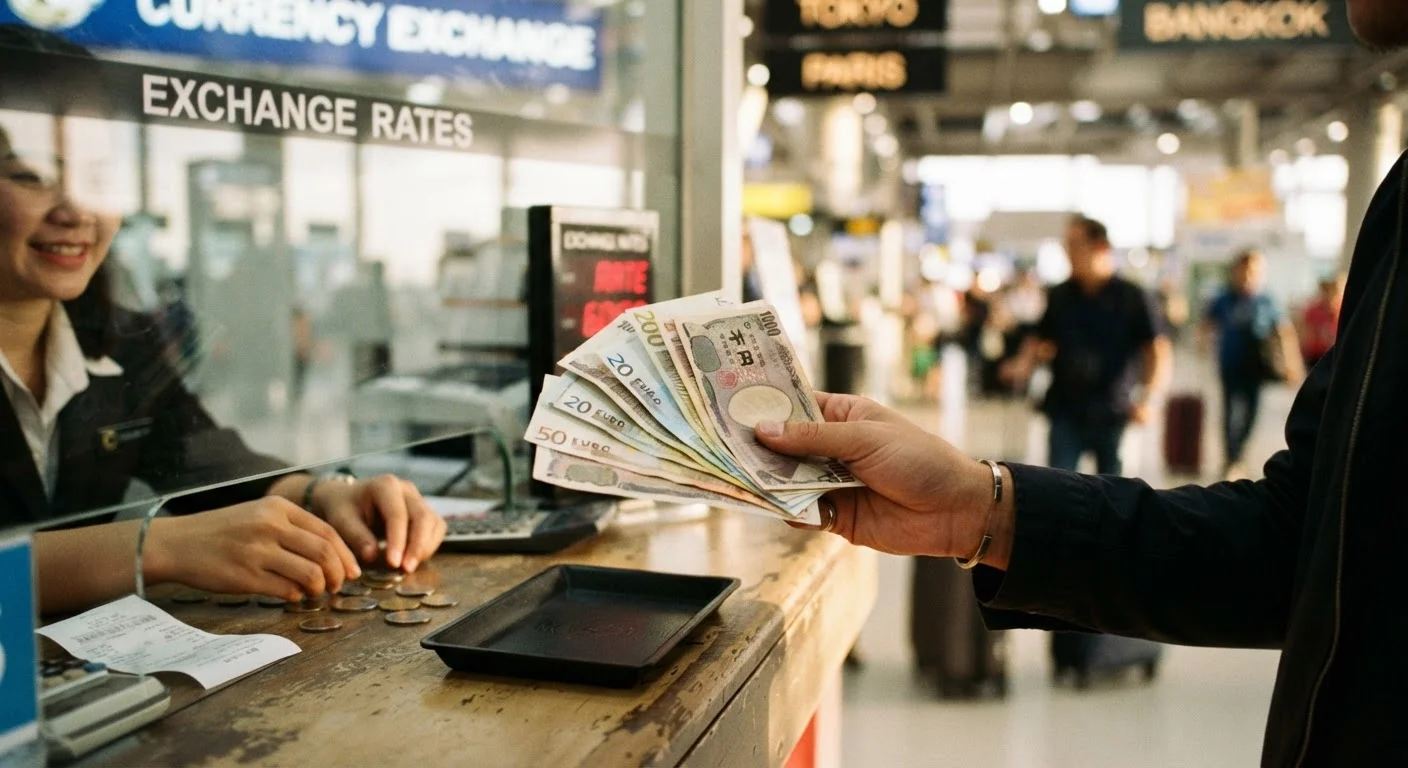
Photo credit: SearchLynk.net | Search Made Easier
In this article
Understand how currency exchange works while traveling, what foreign transaction fees are, and the key questions to ask before you go.
Key Takeaways
- The exchange rate you see advertised is rarely the rate you actually receive as a traveler.
- Foreign transaction fees of 1%-3% are charged per purchase by many U.S. credit and debit cards.
- Airport and hotel currency exchange counters typically offer the least favorable rates.
- Dynamic Currency Conversion (DCC) can cost you extra - always choose to pay in local currency.
- Checking your card's fee structure before departure is one of the simplest ways to protect your budget.
Why These Costs Catch Travelers Off Guard
Most travelers budget carefully for flights, hotels, and activities - then discover upon returning home that their bank statement tells a different story. Currency conversion costs and card fees are easy to overlook because they're invisible at the moment of spending. You swipe your card at a restaurant in Barcelona or withdraw cash in Tokyo, and the transaction feels identical to one at home. The extra charges appear later, embedded in statements and receipts that few travelers scrutinize carefully.
Understanding how these costs work - before you travel - is one of the most practical steps any international traveler can take. It doesn't require financial expertise; it just requires knowing what questions to ask. For a broader look at trip costs that often go unnoticed, see hidden travel costs that catch travelers off guard.
Exchange Rates Change Daily
Currency exchange rates fluctuate constantly based on global economic conditions, interest rate decisions, and market sentiment. The rate you see quoted today may differ from the rate available when you travel. For general trip budgeting purposes, using a recent mid-market rate as a planning estimate is reasonable - just build in a small buffer for variability and provider margins.
How Exchange Rates Work in Practice
The exchange rate is the ratio at which one currency converts to another. Banks and currency providers use what's called the mid-market rate as a neutral benchmark - it's the midpoint between buying and selling prices on global currency markets. Travelers, however, almost never receive this rate. Providers make money by offering a slightly less favorable rate and pocketing the difference, known as a spread.
The spread varies significantly by provider. Currency exchange booths at international airports are notorious for wide spreads - sometimes 10% or more above the mid-market rate. Local ATMs in your destination country tend to offer tighter spreads, though your home bank may layer on its own ATM withdrawal fee. The practical implication: where and how you exchange money matters as much as when.
1%-3%
Typical foreign transaction fee range per purchase
This fee range is commonly disclosed in U.S. bank and credit card agreements for international transactions made in foreign currencies.
Up to 10%+
Potential spread at airport currency exchange booths
Independent currency market analysts and consumer finance publications have noted that airport exchange counters frequently offer rates significantly below the mid-market benchmark.
$90-$120
Extra fees on a $3,000-$4,000 trip at 3%
A straightforward calculation illustrating how a standard 3% foreign transaction fee accumulates across a typical two-week international trip budget.
If you're building your international travel budget from scratch, Travel Budgeting From the Ground Up walks through how to factor in these types of costs across your full trip.
Foreign Transaction Fees: Small Percentages, Real Dollars
A foreign transaction fee is a surcharge your bank or card issuer applies when you pay in a foreign currency. It's typically between 1% and 3% of each transaction. That may sound negligible - but consider a two-week trip where you spend $4,000 total. At 3%, that's $120 charged purely in fees on top of what you actually purchased.
These fees apply to both credit and debit card transactions in foreign currencies. Some cards also apply them to purchases made in U.S. dollars through a foreign merchant's payment processor, which can feel counterintuitive. Checking your card's terms before departure - specifically whether it charges a foreign transaction fee - is one of the simplest and most cost-effective pre-trip steps available to any traveler.
Check Your Card's Terms Before You Pack
Call the number on the back of your card or review your online account agreement and search for 'foreign transaction fee.' This takes about five minutes and tells you exactly what you'll be charged on international purchases. Some travelers discover they already hold a card with no foreign transaction fee - they simply weren't aware of it.
Dynamic Currency Conversion: A Hidden Choice at the Register
Dynamic Currency Conversion, or DCC, is a feature offered by some foreign merchants and ATMs. When you pay with a U.S. card, the terminal may ask whether you'd like to be charged in your home currency (U.S. dollars) rather than the local currency. It's framed as a convenience - you can see exactly what you'll pay in familiar terms.
In practice, DCC typically costs you more. The merchant or payment processor sets the conversion rate, and it's almost always less favorable than the rate your card issuer would apply. Choosing to pay in the local currency at every opportunity - and declining DCC when prompted - is a straightforward habit that costs nothing to adopt and can reduce unnecessary conversion losses across dozens of transactions on a trip.
For travelers heading abroad for the first time, What Every First-Time International Traveler Should Know Before Booking covers this and other foundational topics worth understanding before you depart.
Practical Steps Before You Leave
You don't need to become a currency expert to protect your travel budget. A few focused questions before your trip can make a meaningful difference:
- Does your card charge a foreign transaction fee? Check your card agreement or call your bank. If it does, consider whether another card in your wallet doesn't.
- What ATM fees will apply abroad? Some banks reimburse foreign ATM fees; many don't. Know your bank's policy in advance.
- Will you need local cash on arrival? If so, exchanging a modest amount before you leave - at your home bank rather than an airport kiosk - often produces a better rate.
- What's the local payment culture? Some destinations are largely cash-based; others are highly card-friendly. Research your specific destination.
Currency costs are just one category of expenses that can surprise travelers. Traveling on a Fixed Budget offers a framework for thinking through all stages of your trip's spending in an organized way.
Frequently Asked Questions

Author
Travel & Trips Editorial Team
Travel & Trips Editorial Team is the collective byline for our editorial team and contributor network. Articles published under this byline or an editorial pen name are researched, written, and reviewed according to our editorial standards for clarity, consistency, and independence before publication.
View all articles →