
What 'Unlimited' Really Means on a Phone Plan
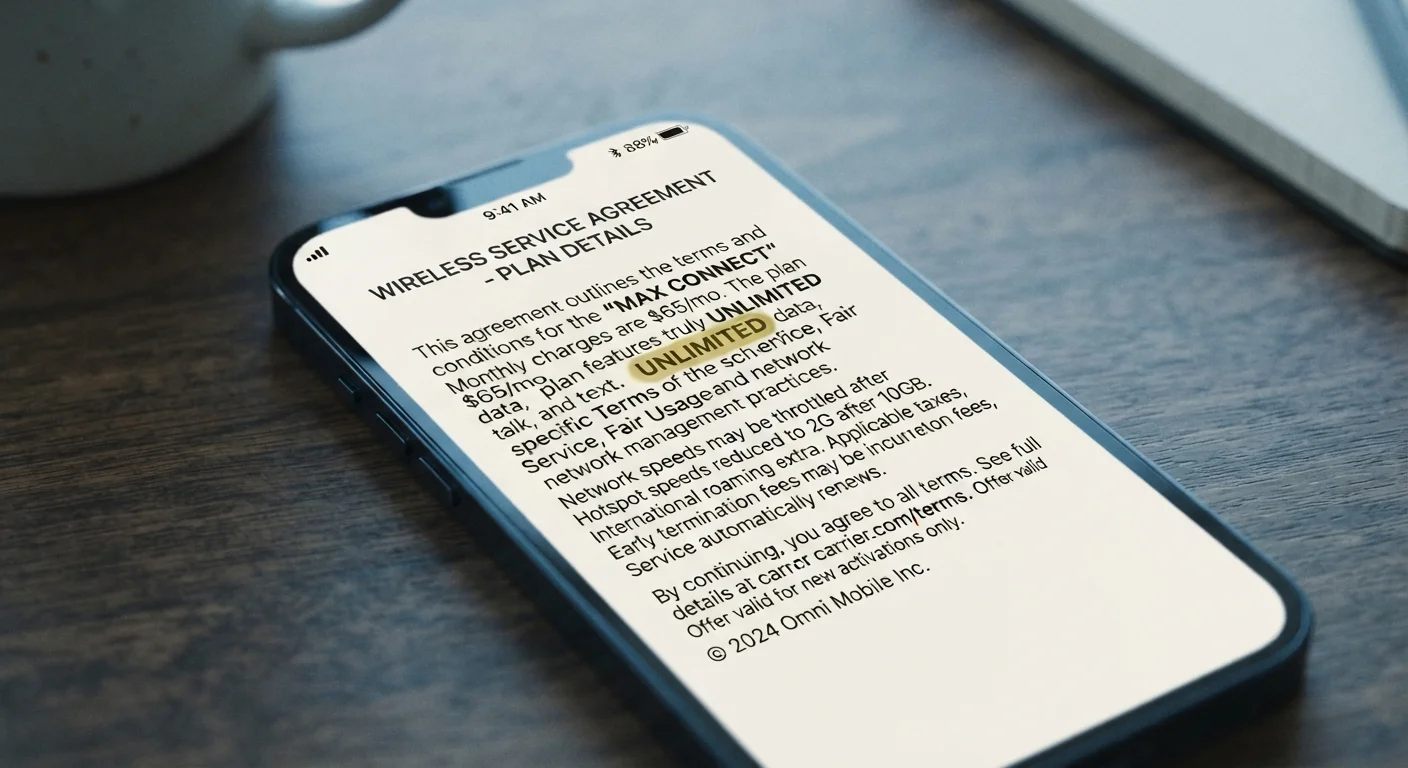
Photo credit: SearchLynk.net | Search Made Easier
In this article
Carriers market unlimited data, but fine print often tells a different story. Learn what deprioritization, throttling, and caps mean in practice.
Key Takeaways
- Most unlimited plans include speed throttling after a set data threshold is reached.
- Deprioritization can slow your connection during network congestion, even on premium tiers.
- Hotspot data on unlimited plans is almost always capped at a separate, lower limit.
- Video streaming quality is frequently restricted on lower-tier unlimited plans.
- Reading the plan's full terms - not just the marketing headline - is essential before signing up.
The Gap Between 'Unlimited' Marketing and Reality
The word "unlimited" sells phone plans. It conjures the image of streaming, browsing, and downloading without ever watching a data meter. But wireless carriers use the term in ways that don't always match what most people would call truly unlimited. Understanding the gap between the marketing language and the fine print is the first step toward choosing a plan that actually fits how you use your phone.
For a plain-language reference on the terms carriers use, see the Wireless Plan Jargon, Decoded - it covers everything from deprioritization to hotspot allotments in clear terms.
Myth
An unlimited plan means you can use as much data as you want at full speed, all month long.
Fact
Most unlimited plans reduce speeds after a set usage threshold, a practice called throttling.
Carriers set a full-speed data ceiling - often ranging from 22 GB to 100 GB depending on the plan tier - after which your connection speed is capped for the remainder of the billing cycle. The reduced speed is typically sufficient for basic tasks but noticeably impacts video streaming and file downloads. This threshold is disclosed in the plan's terms, though rarely in the headline advertising.
Myth
Deprioritization only affects very heavy data users and won't impact me in normal use.
Fact
Deprioritization can affect any subscriber who has exceeded the plan's priority data threshold, regardless of how their usage compares to others.
When a cell tower becomes congested, carriers manage traffic by temporarily lowering the connection quality for subscribers who have used more than a set amount of data in the current billing period. This can happen in densely populated areas, at large events, or during peak evening hours - situations that are common rather than exceptional. The slowdown is temporary and resolves when congestion clears, but it can be significant in the moment.
Myth
Unlimited data means unlimited hotspot - I can use my phone to connect my laptop all month without restrictions.
Fact
Hotspot data on unlimited plans is almost always governed by a separate, lower cap with its own speed ceiling.
Mobile hotspot is treated as a distinct feature on virtually all unlimited plans. Entry-level unlimited tiers may include a limited amount of full-speed hotspot data - sometimes as little as 5 GB - before the hotspot connection is throttled to speeds too slow for most laptop use. Premium unlimited tiers offer more hotspot data at full speed, but the allowance is still finite. If hotspot connectivity is a priority, this is one of the most important line items to check when comparing plans.
Myth
All unlimited plans include HD video streaming as a standard feature.
Fact
Many unlimited plans - particularly entry-level tiers - cap video streaming at standard definition (480p) by default.
Carriers use video resolution management to reduce the bandwidth load on their networks. On lower-tier unlimited plans, video is often streamed at 480p regardless of the content platform's available quality. Unlocking HD or 4K streaming may require a higher plan tier or a paid add-on. This restriction applies to mobile data connections; streaming over Wi-Fi is unaffected by the carrier's policy.
Myth
Unlimited plans have no fine print - what's advertised is what you get.
Fact
Carriers are required by the FCC to disclose all material network management practices, meaning the limitations are documented - just not always prominently.
Regulatory guidance from the Federal Communications Commission (FCC) requires carriers to disclose network management practices, including throttling and deprioritization policies. These disclosures exist in plan terms and broadband facts labels, but they are rarely featured in advertising. Reading the full plan terms - or a reliable plain-language summary - before purchasing is the most reliable way to understand what an unlimited plan actually provides.
What the Fine Print Actually Controls
Carriers legally disclose the conditions attached to unlimited plans, but that disclosure is often buried in terms-of-service documents or presented in small text well below the headline price. Three mechanisms do most of the work: throttling (a hard speed reduction after a data threshold), deprioritization (a conditional slowdown during congestion), and feature-level caps (restrictions on hotspot speeds, video resolution, or roaming).
22-100 GB
Typical full-speed data threshold before deprioritization
Most major U.S. carriers publish priority data thresholds in their plan terms, ranging from around 22 GB on entry tiers to 100 GB or more on premium unlimited plans.
600 Kbps
Hotspot speed after full-speed allotment is exhausted
A common throttled hotspot speed disclosed in carrier terms; at this rate, most video calls and file transfers are significantly impaired.
Throttling is the more predictable of the two speed controls - once you hit the threshold, speeds drop to a fixed ceiling, typically 1.5 Mbps to 3 Mbps, for the rest of the billing cycle. That's adequate for basic messaging but will noticeably degrade video calls and streaming. Deprioritization, by contrast, is situational: on a congested tower, subscribers who have exceeded a certain usage threshold are moved to the back of the queue. On an uncongested tower, those same subscribers may experience full speeds. Neither mechanism is inherently deceptive, but neither is clearly communicated in an advertisement.
Feature-level caps are where many readers are most surprised. Hotspot data - the ability to share your phone's connection with a laptop or tablet - is almost universally restricted on unlimited plans. Entry-level tiers often provide 5 GB to 15 GB of hotspot data at full speed, then drop to 600 Kbps, which is too slow for most laptop tasks. If mobile hotspot is important to your workflow, it's worth reading the plan's hotspot policy specifically, not just the data headline. Our guide on reading a phone plan the right way walks through exactly how to evaluate these details before committing.
Don't Rely on Plan Names Alone
Carrier plan names like "Unlimited Plus" or "Unlimited Premium" are marketing labels, not standardized categories. Two plans with similar names from different carriers can have very different throttling thresholds, hotspot allowances, and deprioritization policies. Always compare the specific terms - data thresholds, hotspot caps, video resolution limits - rather than relying on tier names to indicate equivalent value.
Unlimited plans also vary in how they handle international roaming, domestic roaming on partner networks, and video streaming resolution. Some plans cap video at 480p (standard definition) by default, requiring an add-on or a premium tier to unlock HD. These aren't bugs - they're deliberate product tiers - but they matter when you're comparing plans side by side.
If you're weighing a no-contract option, be aware that those plans carry their own version of these trade-offs. The trade-offs of no-contract phone plans article lays out both the flexibility and the limitations clearly.
How to Evaluate an Unlimited Plan on Its Actual Terms
Before selecting an unlimited plan, it helps to ask a specific set of questions about your own usage patterns. Do you regularly stream video on mobile data, or mainly on Wi-Fi? Do you use your phone as a hotspot for other devices? Do you travel to areas with weaker coverage, where network congestion or roaming policies are more likely to affect you?
Once you know your priorities, look for answers to these questions in the plan's actual terms rather than its marketing page: What is the full-speed data threshold before throttling applies? Under what conditions does deprioritization apply, and to which tier of subscriber? How much hotspot data is included at full speed, and what speed does it drop to after that? Is video resolution capped, and if so, at what quality? What are the domestic and international roaming terms?
Carriers are required to publish these details, and they do - but often not prominently. If a plan's terms aren't clear from the provider's website, calling customer service and asking directly is a reasonable approach. Keeping a record of the answers you receive before signing is also worthwhile. Patterns of overpayment often start at the point of signup, when features are assumed rather than confirmed - a dynamic explored in detail in the piece on why people overpay for phone plans.
The bottom line: "unlimited" is a legally permissible marketing term, not a technical specification. Reading the plan's actual data policy - not its tagline - is the only reliable way to know what you're buying.

Author
Tech & Telecom Editorial Team
Tech & Telecom Editorial Team is the collective byline for our editorial team and contributor network. Articles published under this byline or an editorial pen name are researched, written, and reviewed according to our editorial standards for clarity, consistency, and independence before publication.
View all articles →