
How Mobile Network Coverage Actually Works
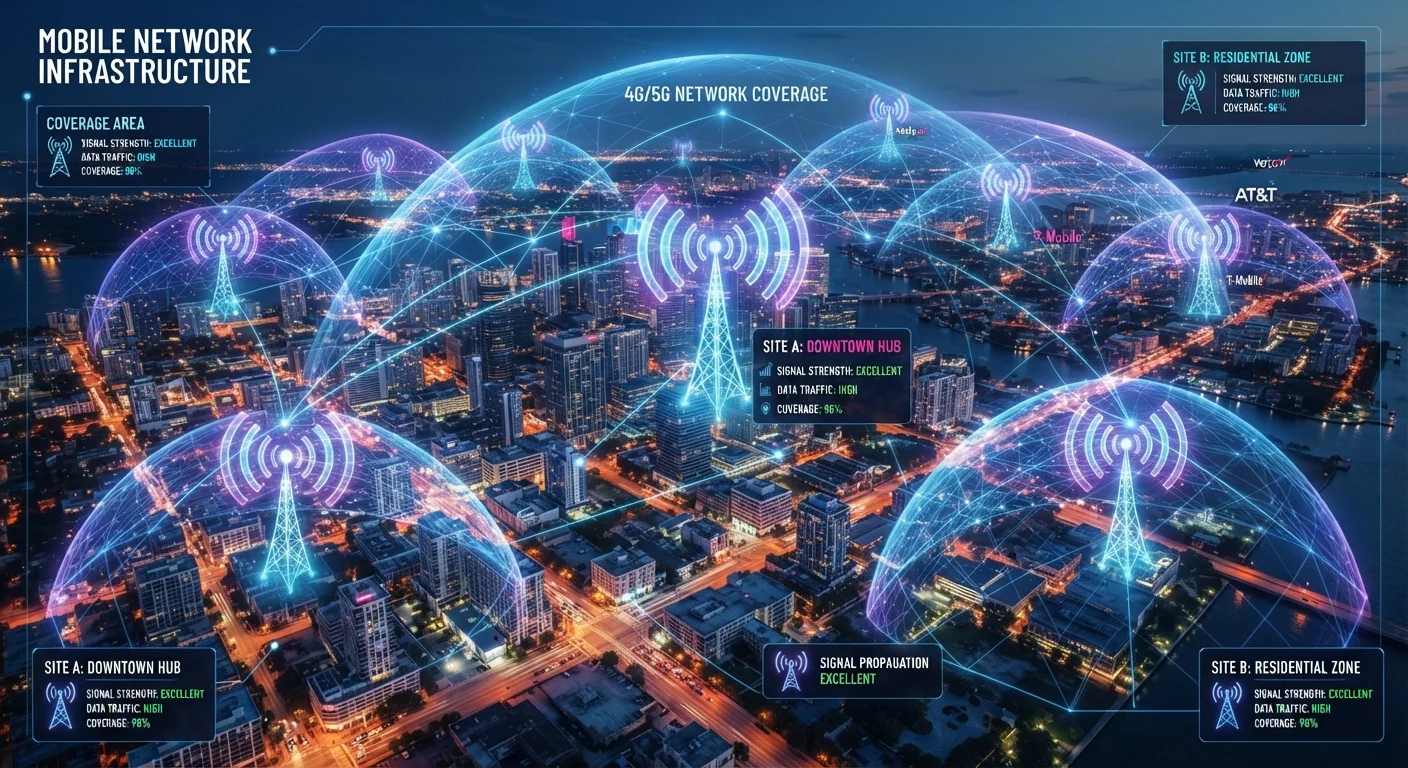
Photo credit: SearchLynk.net | Search Made Easier
In this article
Signal strength, band frequency, and tower density all shape your experience. This explainer shows what coverage maps do and don't tell you.
Key Takeaways
- Coverage maps show estimated signal reach, not guaranteed real-world performance.
- Lower-frequency bands travel farther and penetrate buildings better; higher frequencies offer faster speeds in smaller areas.
- Tower density matters as much as tower count - urban areas have more towers but more competing devices.
- MVNOs use the same physical towers as major carriers but may have different priority levels on the network.
- Your phone's hardware affects how well it uses available coverage, independent of your carrier.
What a Coverage Map Is Really Showing You
Every major carrier publishes a coverage map, and nearly every one looks impressively comprehensive. But those colorful overlays represent predicted signal availability, not measured performance at any specific address. Maps are built using tower location data, terrain models, and signal propagation algorithms - tools that estimate where a signal should reach under typical conditions.
The catch: conditions are rarely typical. Hills, dense forests, tunnels, and even clusters of tall buildings can all degrade signal in ways a map won't capture. That's why two people standing in a "covered" zip code can have drastically different experiences depending on which side of a ridge they're on.
Coverage maps also don't distinguish between strong and marginal signal. An area shown as covered might have just enough signal for a voice call but not enough for streaming video. For a deeper breakdown of what carriers mean when they advertise network capabilities, see our plain-language wireless glossary.
~83%
U.S. land area with limited or no coverage
The FCC has noted that major carriers cover the vast majority of the U.S. population, but large portions of rural land area remain underserved due to sparse tower deployment.
3x
Speed variation within same coverage zone
Independent network testing firms have documented that measured data speeds can vary by 3x or more within a single zip code depending on tower load and band availability.
600 MHz
Low-band frequency range start
Signals in the 600-900 MHz range can travel dozens of miles from a single tower under ideal conditions, making them critical for rural and building-interior coverage.
How Frequency Bands Shape Your Signal
The radio spectrum used for wireless communication is divided into frequency bands, and the band your phone connects to matters enormously. Think of it this way: low-frequency signals act like long, rolling waves - they travel farther and pass through obstacles more easily. High-frequency signals are shorter and faster but lose energy quickly over distance and through walls.
- Low-band spectrum (600-900 MHz): Excellent range and building penetration. This is what blankets rural areas and keeps signals alive indoors. Trade-off: slower data speeds.
- Mid-band spectrum (1-6 GHz): A practical balance of coverage and speed. Mid-band 5G, particularly around 2.5 GHz, has become the workhorse of modern 5G deployments in suburban and urban areas.
- High-band / mmWave (24-47 GHz): Blazing speeds but extremely limited range - often measured in hundreds of feet. Practical mainly in dense, controlled environments like stadiums or convention centers.
Understanding these trade-offs helps explain why a carrier can claim "nationwide 5G" while many customers experience only modest speed improvements. Our explainer on 4G LTE, 5G Sub-6, and mmWave goes further into how these technologies compare in real-world use.
“The frequency spectrum is like real estate - location and characteristics determine value. Low-band is the suburbs: lots of room, easy access. mmWave is prime downtown: incredibly valuable but only if you're right there.”
— Harold Feld, Senior Vice President, Public Knowledge - telecommunications policy advocate
Tower Density, Congestion, and What They Mean for You
More towers in an area generally means more reliable coverage - but it doesn't automatically mean faster speeds. Every tower has a finite capacity, and in densely populated areas, that capacity is shared among every device connected to it. Rush hour doesn't just happen on highways; network congestion follows similar patterns during morning commutes, lunch breaks, and major events.
Carriers manage congestion through a hierarchy of service tiers. Customers on premium unlimited plans typically receive higher network priority than those on budget tiers or MVNOs (mobile virtual network operators). MVNOs lease access to major carrier infrastructure and cover the same geography, but their customers may be deprioritized when towers are under load. This is worth understanding before choosing a plan purely on price. Our complete guide to U.S. wireless carrier plans walks through how plan tiers and network priority interact.
Test Before You Commit
Many carriers offer trial periods or short-term prepaid options that let you test real-world performance at your home, workplace, and commute route before porting your number. This hands-on test reveals congestion and indoor coverage issues that no map can predict. Asking friends or colleagues in your area about their experience on a given carrier is equally valuable.
Your Phone's Role in the Equation
Coverage isn't solely a carrier story - your device is an active participant. A phone must support the specific frequency bands a carrier deploys in your area. A handset that lacks mid-band 5G support won't access those speeds even if you're standing in the middle of prime mid-band coverage. Similarly, older phones may only support 4G LTE bands, capping your experience regardless of what the network offers.
This matters most when switching carriers or purchasing an unlocked device internationally. Band compatibility varies by market, and a phone designed for one region may only partially work on another carrier's network. Checking a phone's band specifications against a carrier's spectrum holdings before purchasing is a practical step most people skip - but it's one of the clearest ways to avoid coverage disappointment.
For broader context on how devices interact with wireless plans, our Devices & Gadgets hub covers smartphones and connected devices in detail. And if you're still building foundational knowledge about how wireless plans work overall, Phone Plans Explained is a useful starting point.
Frequently Asked Questions

Author
Tech & Telecom Editorial Team
Tech & Telecom Editorial Team is the collective byline for our editorial team and contributor network. Articles published under this byline or an editorial pen name are researched, written, and reviewed according to our editorial standards for clarity, consistency, and independence before publication.
View all articles →