
Shared vs. Dedicated Bandwidth: The Hidden Factor in Your Internet Experience
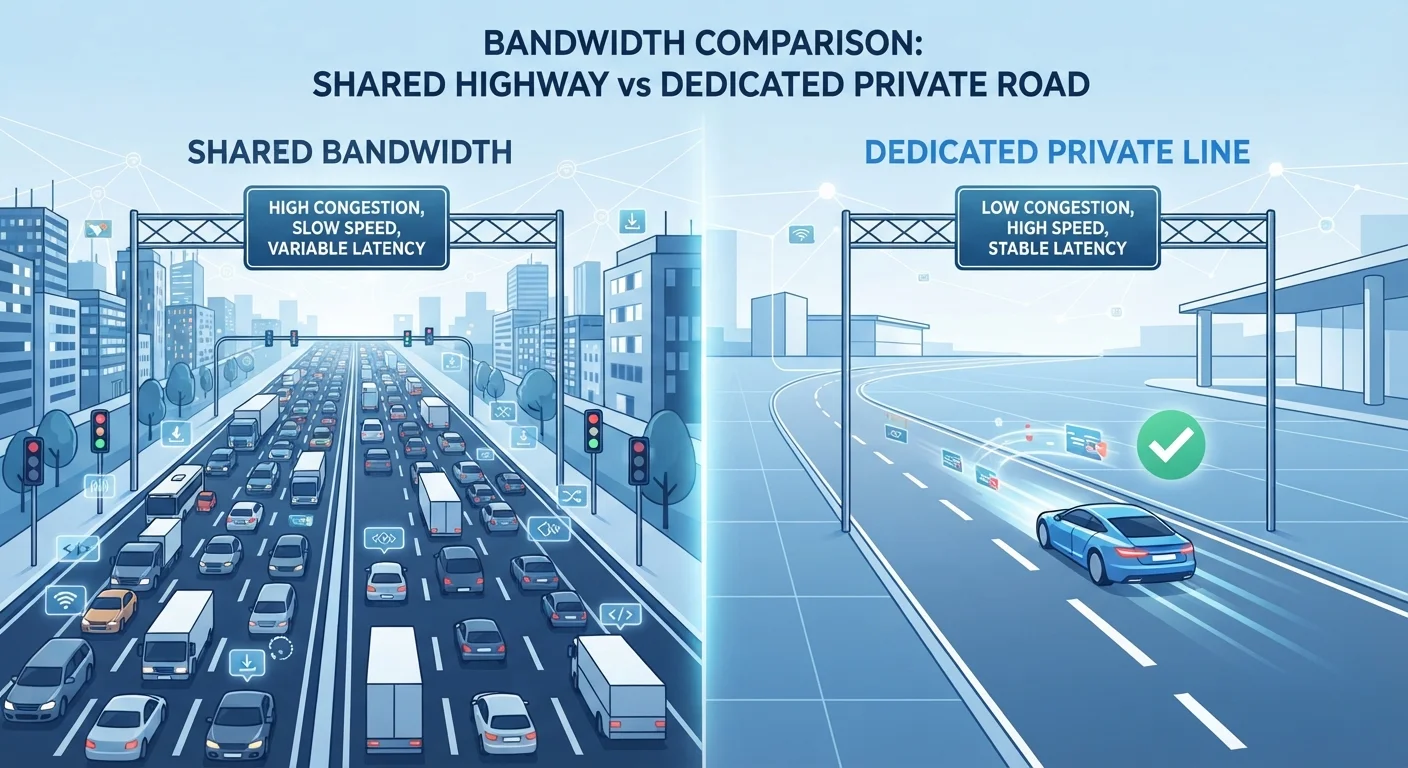
Photo credit: SearchLynk.net | Search Made Easier
In this article
Not all broadband connections are created equal. Understand how shared and dedicated bandwidth models affect the speed you actually get.
Key Takeaways
- Most residential broadband plans - including cable - use a shared bandwidth model.
- Shared bandwidth can cause slowdowns during peak evening hours when many neighbors are online simultaneously.
- Fiber-to-the-home and some business-grade services are more likely to offer dedicated or near-dedicated bandwidth.
- Advertised speeds reflect the maximum possible, not a guaranteed minimum under a shared model.
- Understanding your connection type helps you set realistic expectations and choose the right plan.
The Pipe Analogy: How Bandwidth Actually Works
Think of your internet connection as a water pipe running into your home. The width of that pipe determines how much data can flow through it at any given moment. Bandwidth - measured in megabits per second (Mbps) or gigabits per second (Gbps) - is essentially that pipe's capacity.
What many people don't realize is that, depending on your connection type, that pipe may be shared with dozens or even hundreds of nearby households. When everyone draws from the same source at once, pressure drops for everyone. This is the core dynamic separating shared from dedicated bandwidth - and it has a direct effect on the speeds you experience in real life, not just the numbers printed on your plan.
For a broader look at how different connection technologies work, see our home internet explainer before diving deeper into bandwidth models.
Shared Bandwidth: The Default for Most Home Subscribers
Cable broadband - still the most widely available high-speed option across the U.S. - operates on a shared architecture. The coaxial cable running into your home is part of a larger local loop that serves your entire neighborhood. Providers engineer their networks with the assumption that not every subscriber will be online at full speed simultaneously, a practice called statistical multiplexing.
This model works well most of the time. During daytime hours or overnight, a shared connection may perform at or near its advertised speed. But when demand peaks - typically weekday evenings between 7 and 11 p.m. - the shared segment fills up and speeds dip noticeably. This is what's commonly called network congestion.
~7 p.m.-11 p.m.
Peak congestion window for residential broadband
Network performance data consistently shows evening hours drive the highest residential internet demand, when shared network segments experience the most strain.
"Up to"
How advertised speeds are qualified by providers
Federal broadband labeling requirements in the U.S. mandate disclosure of typical speeds, recognizing that maximum advertised speeds are not always achievable under shared network conditions.
~45%
U.S. households with access to fiber broadband
According to Federal Communications Commission (FCC) broadband data, fiber availability has grown substantially in recent years but remains unavailable to many American households.
It's worth noting that advertised speeds under a shared model are always theoretical maximums, not guarantees. Providers typically include language like "up to" in plan descriptions for exactly this reason. Our internet myths article covers why "more Mbps" doesn't always translate to a better experience.
Dedicated Bandwidth: Reserved Capacity, Fewer Surprises
Dedicated bandwidth means your allocated capacity isn't shared with neighbors. The capacity you're paying for is reserved for your connection, regardless of how many people in your area happen to be streaming at the same time.
Fiber-to-the-home (FTTH) services - where a fiber optic line runs directly to your residence - come closest to this model for residential customers. Because fiber has substantially greater raw capacity than coaxial cable and because many fiber deployments use point-to-point or near-dedicated architecture, congestion is far less common. Some providers do introduce sharing at certain points in the network even on fiber, so it's worth asking your provider about the specifics for your address.
True dedicated bandwidth at a guaranteed rate is most commonly found in business-grade service tiers, which come at a higher cost. For most households, fiber broadband offers a practical middle ground. Learn how fiber and cable compare in real-world use in our fiber vs. cable breakdown.
What This Means When Choosing a Plan
Understanding the shared vs. dedicated distinction helps reframe how you evaluate internet plans. Raw speed numbers matter, but so does the consistency of those speeds under real-world conditions.
A few practical considerations:
- Check the connection technology, not just the speed tier. Two plans advertising 300 Mbps can perform very differently if one is cable and one is fiber.
- Ask about contention ratios. Some providers, particularly smaller regional ISPs, will disclose how many subscribers share a given network segment. Lower ratios mean less potential congestion.
- Match your plan to your household's actual usage patterns. Heavier users - multiple simultaneous streamers, remote workers on video calls - may feel the effects of shared congestion more acutely. Our household speed guide can help you estimate what your home genuinely requires.
Bandwidth type is one piece of a larger decision. For a complete framework - covering connection types, speed tiers, contracts, and equipment - the complete home internet roadmap walks through the full process.
Frequently Asked Questions

Author
Tech & Telecom Editorial Team
Tech & Telecom Editorial Team is the collective byline for our editorial team and contributor network. Articles published under this byline or an editorial pen name are researched, written, and reviewed according to our editorial standards for clarity, consistency, and independence before publication.
View all articles →