
Fiber vs. Cable Internet: What Sets Them Apart for Everyday Use
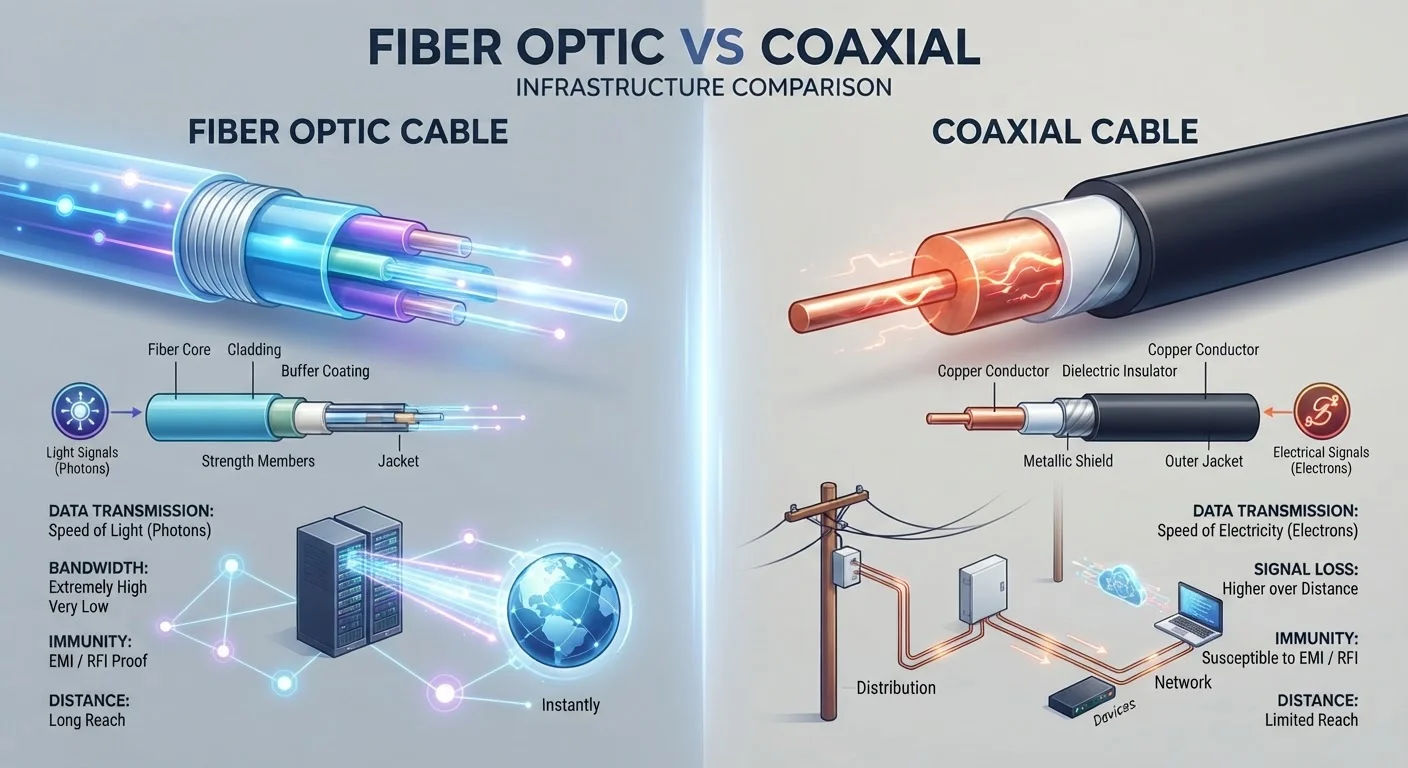
Photo credit: SearchLynk.net | Search Made Easier
In this article
Fiber and cable are the two most common broadband options. Here's how they differ in speed, reliability, and real-world performance.
Key Takeaways
- Fiber uses light signals through glass strands; cable uses electrical signals through coaxial copper lines.
- Fiber typically offers symmetrical upload and download speeds; cable upload speeds are usually much slower.
- Cable internet is shared infrastructure in your neighborhood, which can slow speeds during peak hours.
- Fiber availability is expanding but still lags behind cable in many suburban and rural areas.
- Neither technology is universally superior - your best option depends on local availability and actual household needs.
How Each Technology Actually Works
The most fundamental difference between fiber and cable internet is what carries the signal to your home. For a broader overview of all connection types, see Home Internet Explained.
Fiber internet transmits data as pulses of light through thin strands of glass or plastic - a technology called fiber optic cable. Because light travels with minimal interference and degrades very little over distance, fiber connections tend to be fast and stable regardless of how far you are from the provider's facility.
Cable internet runs over the same coaxial copper lines that originally delivered cable television. Electrical signals carry internet data through this infrastructure. While providers have significantly upgraded cable networks over the decades - through standards like DOCSIS (Data Over Cable Service Interface Specification) - the underlying physics of copper still impose limits that glass fiber doesn't face.
This infrastructure difference isn't just technical trivia. It directly shapes the speed, reliability, and consistency you experience at home every day.
| Criterion | Fiber Internet | Cable Internet |
|---|---|---|
| Signal medium | Light through glass/plastic fiber | Electrical signal through coaxial copper |
| Download speeds | Very high; up to multi-gigabit | High; typically up to 1 Gbps on modern plans |
| Upload speeds | Symmetrical (matches download) | Asymmetrical (often much slower) |
| Peak-hour congestion | Generally lower risk | More susceptible due to shared nodes |
| Weather/interference sensitivity | Low; not affected by electrical interference | Moderate; copper more vulnerable to interference |
| Availability | Expanding but still limited in many areas | Widely available across most of the US |
| Infrastructure age | Newer; purpose-built for broadband | Older; repurposed from TV cable systems |
Speed, Upload, and the Congestion Problem
When most people compare internet connections, they focus on download speed - how fast a page loads or a video buffers. But upload speed matters too, especially for remote work, video calls, cloud backups, and gaming.
Fiber connections are typically symmetrical, meaning upload and download speeds are roughly equal. Cable connections are generally asymmetrical - download speeds are prioritized, while upload speeds are often a fraction of that. A cable plan advertised at 300 Mbps down might offer only 20-30 Mbps up.
There's another consideration with cable: it operates on a shared network node. Multiple households in a neighborhood draw from the same local bandwidth pool. During peak hours - evenings, weekends - this shared infrastructure can become congested, causing speeds to drop noticeably. Fiber infrastructure is generally less susceptible to this neighborhood-level congestion. To understand why shared versus dedicated bandwidth matters in practice, see Shared vs. Dedicated Bandwidth.
~43%
US households with fiber broadband access
According to the FCC's broadband deployment data, fiber availability has grown significantly but still reaches fewer than half of US homes.
~90%+
US households with cable broadband access
Cable infrastructure has been built out broadly over decades, making it the most widely accessible high-speed wired option in the country.
Up to 10x
Difference in upload speed between fiber and cable
On comparable advertised download tiers, fiber plans commonly offer upload speeds five to ten times higher than equivalent cable plans.
Availability, Reliability, and What to Realistically Expect
Cable internet has a significant practical advantage: availability. Cable infrastructure was built out broadly over decades across urban, suburban, and many rural markets. Fiber, while expanding, is still concentrated in newer developments, denser urban areas, and regions where providers have made active infrastructure investments.
On reliability, fiber generally has an edge. Because glass fiber isn't susceptible to electrical interference - from weather, nearby power lines, or signal crosstalk - it tends to deliver more consistent performance. Cable networks have improved substantially, but physical copper lines remain more vulnerable to certain types of interference and degradation over long runs.
It's worth noting that even excellent backbone infrastructure doesn't guarantee your in-home experience. Router placement, Wi-Fi band selection, and home wiring all affect what you actually feel as a user. Don't overlook those variables when evaluating your connection. For context on what internet speeds mean in practical terms, Common Myths About Home Internet addresses several widespread misconceptions worth reading before you decide.
If neither fiber nor cable serves your address, other technologies may be worth exploring. Fixed wireless and satellite internet are two alternatives specifically designed for areas underserved by traditional wired broadband.
Check Your Address, Not Just the Technology
Whether fiber or cable is 'better' is secondary to what's actually available at your specific address. Providers vary significantly by region, and even within a city, coverage boundaries can differ block by block. Before weighing the technical trade-offs, verify what's genuinely offered at your home. A complete roadmap to choosing home internet walks through how to evaluate your options from start to finish.

Author
Tech & Telecom Editorial Team
Tech & Telecom Editorial Team is the collective byline for our editorial team and contributor network. Articles published under this byline or an editorial pen name are researched, written, and reviewed according to our editorial standards for clarity, consistency, and independence before publication.
View all articles →