
The Sunk-Cost Trap: Letting Go of Things You Paid Good Money For
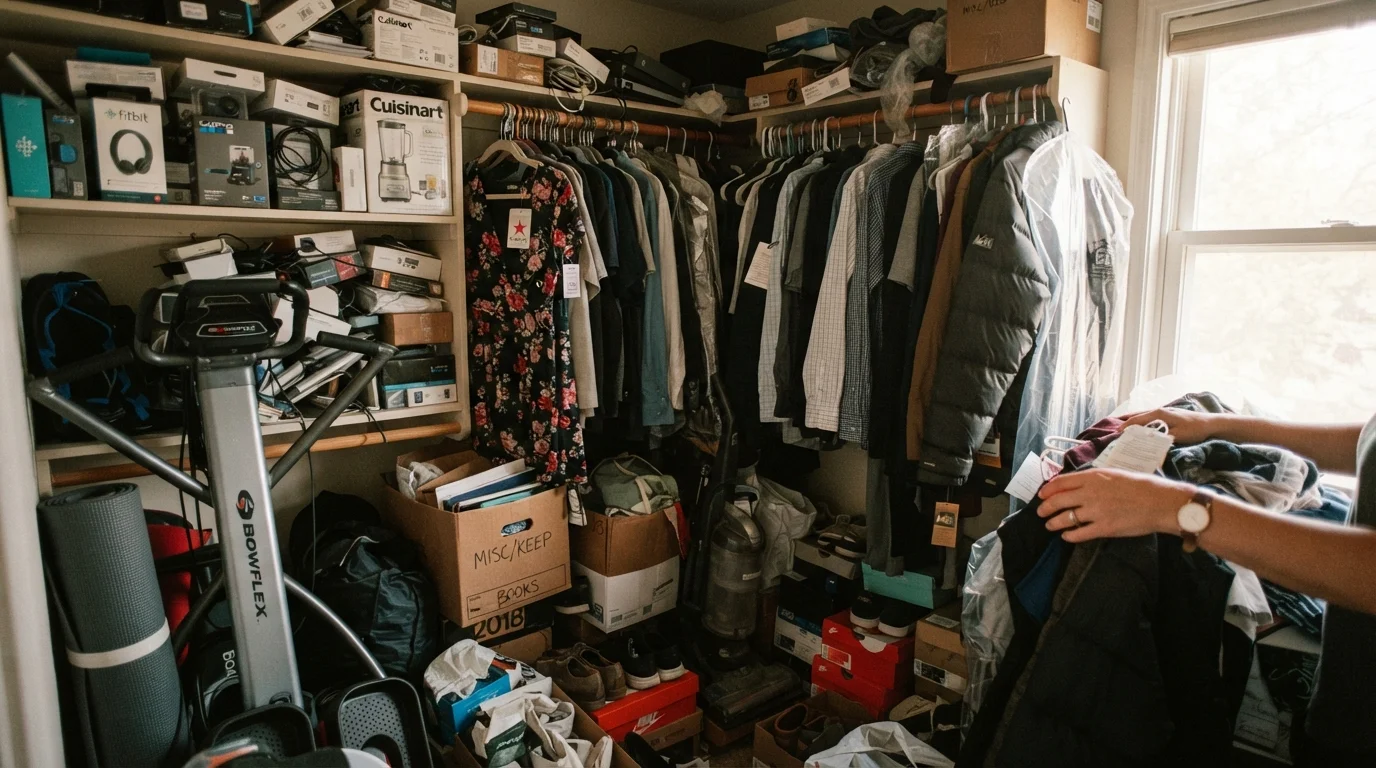
Photo credit: SearchLynk.net | Search Made Easier
In this article
Many people hold onto items simply because they were expensive. Learn what the sunk-cost fallacy is and how it quietly drives clutter in most American homes.
Key Takeaways
- Money already spent on an item cannot be recovered by keeping the item.
- Holding onto unused possessions because they were costly is a recognized cognitive bias.
- Clutter driven by sunk-cost thinking has real ongoing costs: space, maintenance, and mental load.
- Releasing items through donation, resale, or recycling can partially offset the original loss.
- Recognizing the bias is the first and most important step to overcoming it.
Why Letting Go Feels Like Losing Money
Picture the treadmill in the spare bedroom. You paid a significant amount for it, used it twice, and now it holds laundry. You won't sell it, donate it, or move it - because getting rid of it feels like admitting you wasted the money.
This is the sunk-cost fallacy in action. The core problem is a mental accounting error: our brains treat the original purchase price as an ongoing debt that keeping the item somehow repays. In reality, that money left your account the day you bought the treadmill. Whether you keep it or donate it tomorrow, the cost is identical - already gone.
Behavioral economists call this loss aversion: people feel the pain of a loss roughly twice as intensely as they feel the pleasure of an equivalent gain. Letting go of an expensive item feels like incurring a new loss, even though no new financial loss is actually occurring.
“The ability to make a new decision without being held hostage by past ones is one of the most underrated skills in both personal finance and everyday life.”
— Dan Ariely, Behavioral economist and author of Predictably Irrational
How Sunk-Cost Clutter Accumulates at Home
The sunk-cost trap is one of the quieter drivers of household clutter. It rarely arrives all at once. Instead, it compounds gradually: a bread maker kept because it cost $80, a set of golf clubs because they cost $300, a course you paid for and never finished. Each individual item seems reasonable to keep. Together, they fill closets, garages, and storage units.
1 in 4
Americans with a garage that can't fit a car
U.S. Department of Energy research has noted that a significant share of American garages are too full to park a vehicle - often packed with stored possessions.
$1,000+
Average annual self-storage cost per unit
Industry data consistently shows American households collectively spend billions annually on off-site storage, much of it for items that are rarely or never accessed.
80%
Of clutter attributed to disorganization, not lack of space
Professional organizers and home researchers frequently cite decision avoidance - including sunk-cost reluctance - as the primary driver of accumulated household clutter.
The ongoing costs of keeping these items are easy to overlook. Physical space in a home has real value - particularly for renters and homeowners in higher-cost markets, where every square foot matters. Clutter also carries a documented psychological toll, with research consistently linking disordered living spaces to elevated stress and reduced ability to focus. These are current costs being paid right now in exchange for holding onto a past purchase.
This connects to a broader pattern worth examining. Just as small financial habits quietly erode savings, small decisions to keep unused things quietly erode livable space - and peace of mind.
A Practical Framework for Evaluating What to Keep
The most effective tool for cutting through sunk-cost thinking is a simple reframe question: "If I didn't already own this, would I go out and acquire it today - for free?" If the honest answer is no, the item's practical value to your life right now is zero, regardless of its price tag.
Run any kept-but-unused item through this filter:
- Do I use it? Not "have I used it" or "might I use it someday" - but actually, regularly use it in its current condition.
- Does it serve a clear future purpose with a specific date? Seasonal gear and event-specific items can have legitimate homes. Vague "someday" plans typically don't.
- What is the real cost of keeping it? Factor in the space it occupies, any storage costs, and maintenance it requires - costs that are often underestimated, much like the hidden ongoing costs of homeownership.
Try the 'Offer It Free' Test
Before deciding to keep an item, imagine posting it online as a free giveaway. If you feel relieved imagining it gone, that's a useful signal. If you feel reluctant even to give it away for free, examine whether that reluctance is about its genuine usefulness - or simply its original price.
For items with genuine resale value, consider that selling recovers a portion of the original cost - making it the financially rational move, not a surrender. Platforms for secondhand selling exist for nearly every category of household goods. Donating, meanwhile, removes the item's burden while potentially benefiting others.
Going forward, applying this same thinking before a purchase - considering the total cost of ownership rather than just the sticker price - is one of the most effective ways to prevent sunk-cost clutter from forming. Our guide on understanding total cost of ownership before you buy walks through that process in detail.
Changing the Story You Tell Yourself
Much of the sunk-cost trap is narrative. "I can't get rid of that - I spent good money on it" is a story, and like all stories, it can be rewritten. A more accurate version: "I made a purchase that didn't work out as hoped. Keeping this item doesn't change that - but releasing it frees up real space and mental energy today."
This shift doesn't require self-criticism. Purchases that don't pan out are a universal human experience, not a character flaw. Recognizing the sunk-cost bias for what it is - a well-documented quirk of human psychology, not a moral failing - makes it far easier to act on. A calmer, more functional home isn't built by perfect past decisions. It's built by honest present ones.
This article is for general informational and educational purposes only. It does not constitute financial, legal, or professional advice. Readers should consult a qualified professional for guidance specific to their circumstances.
Frequently Asked Questions

Author
Home & Garden Editorial Team
Home & Garden Editorial Team is the collective byline for our editorial team and contributor network. Articles published under this byline or an editorial pen name are researched, written, and reviewed according to our editorial standards for clarity, consistency, and independence before publication.
View all articles →