
Home Workouts vs. Gym Workouts: What Changes and What Stays the Same
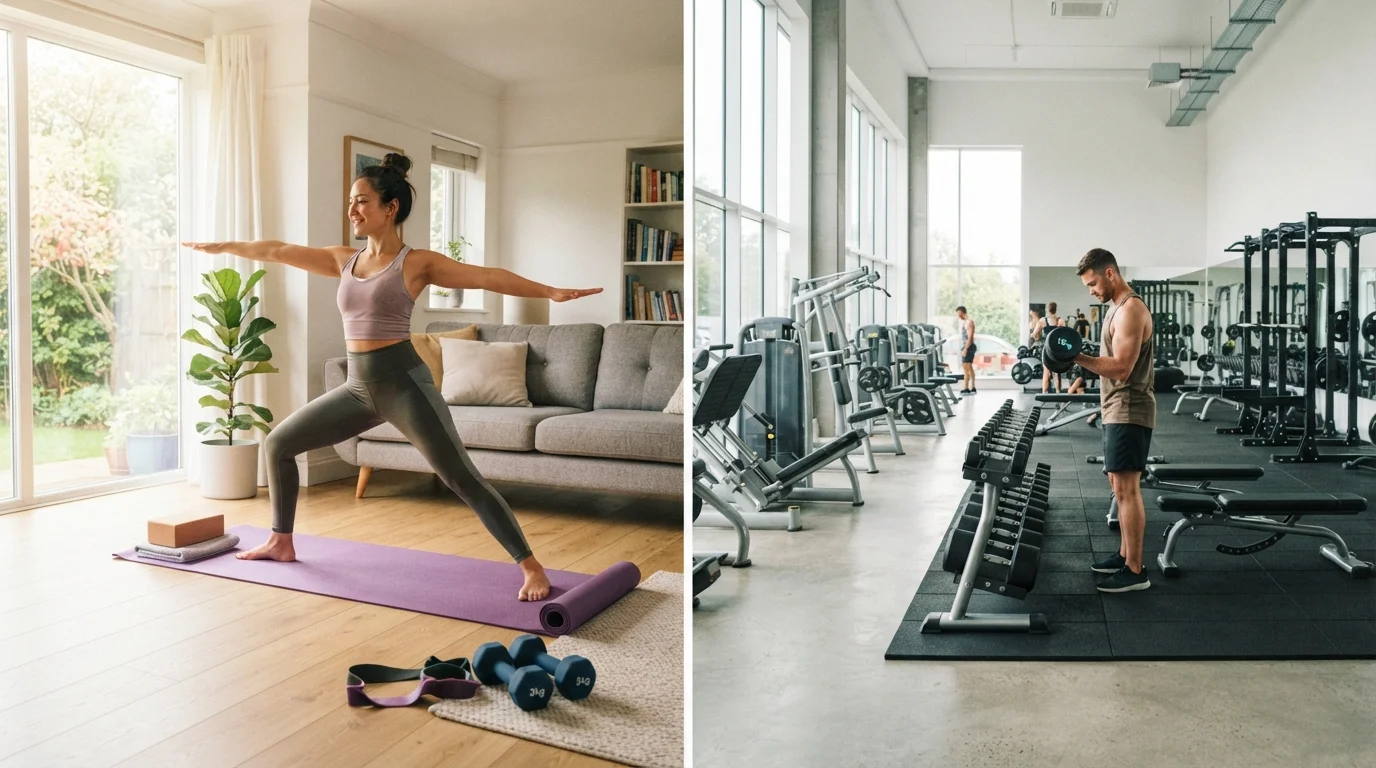
Photo credit: SearchLynk.net | Search Made Easier
In this article
Both settings can produce real results—but they come with different trade-offs. Here's how to think through which environment suits your goals and lifestyle.
Key Takeaways
- The fundamental principles of effective exercise-progressive overload, consistency, recovery-apply equally in both settings.
- Home workouts offer convenience and low cost; gyms provide equipment variety and a structured environment.
- Neither setting is universally superior; the best choice is the one you'll actually stick with.
- Many people find a hybrid approach-combining both settings-works better than committing exclusively to one.
- Always consult a healthcare professional before starting a new exercise program, especially if you have existing health conditions.
The Principles That Never Change
Regardless of where you exercise, the biological principles that drive fitness adaptation stay constant. Progressive overload-gradually increasing the challenge placed on your muscles and cardiovascular system-is what produces improvement over time, whether that challenge comes from a barbell in a gym or a resistance band in your living room. Consistency matters more than location: a moderate routine followed reliably outperforms an aggressive program done sporadically.
Recovery is equally non-negotiable in both settings. Learn more about how rest days support adaptation, regardless of where you train. And if you're just getting started, our guide to starting exercise as an adult with no athletic background walks through the fundamentals that apply universally.
What Actually Differs Between the Two Settings
The meaningful differences between home and gym training are largely practical, not physiological.
| Home Workouts | Gym Workouts | |
|---|---|---|
| Cost | Low ongoing cost after initial setup | Recurring membership fees required |
| Equipment variety | Limited without significant investment | Wide range typically available |
| Convenience | No commute; available any time | Requires travel; subject to hours |
| Environment for focus | Home distractions possible | Dedicated exercise-only space |
| Access to guidance | Self-directed; online resources only | Staff, trainers, and classes on-site |
| Social motivation | Typically solitary | Community and peer energy available |
| Suitability for beginners | Possible with structured online guidance | Easier with in-person support |
Equipment access is the most significant functional gap. Gyms typically offer barbells, cable machines, and a wide range of resistance options that enable certain strength-training progressions difficult to replicate at home without significant investment. For most general fitness goals, however, bodyweight movements, resistance bands, and a modest set of dumbbells cover a substantial range of effective training stimulus.
Environment affects motivation differently for different people. Some individuals find a gym's dedicated atmosphere conducive to focus; others find the commute, crowds, or social dynamics a barrier. Home training removes those friction points but introduces its own distractions-family, screens, or simply the pull of the couch. Neither dynamic is inherently better; it depends on self-knowledge.
Start With What Removes Friction
The most effective workout environment is the one that makes it easiest to show up. Before committing to a gym membership or investing in home equipment, spend a week tracking when and why you actually exercise-or skip it. That pattern often reveals which setting reduces barriers most for your particular lifestyle. A modest, consistent routine in a convenient setting will generally outperform an ambitious plan that's hard to maintain.
Who Tends to Thrive in Each Environment
Home workouts tend to suit people with demanding schedules, those who find gyms socially uncomfortable, parents managing childcare, or anyone working with a limited budget. They also work well for experienced exercisers who understand how to structure their own programming.
Gym workouts tend to benefit beginners who gain from professional guidance, people pursuing specific strength or performance goals that require specialized equipment, and those who draw motivation from a community atmosphere. For a deeper look at how training style affects adherence, see our comparison of group fitness classes versus solo training.
It's also worth noting that fitness needs shift over time. How exercise priorities evolve across adulthood can influence which setting makes more sense at different life stages.
Making the Hybrid Approach Work
A growing number of people find that treating home and gym training as complementary-rather than choosing one permanently-gives them the benefits of both. Gym sessions can cover heavy strength work or group classes; home sessions can handle mobility, conditioning, or lower-intensity recovery workouts. This approach also provides resilience: when a gym membership lapses, travel disrupts routine, or life gets complicated, a home practice means exercise doesn't simply stop.
For those curious about how strength and cardiovascular training fit together across any setting, strength training and cardio don't have to compete-both can be woven into a well-rounded program. And understanding why people abandon new routines can help you build habits that outlast the initial enthusiasm, wherever you train.
This article is for general informational purposes only and does not constitute medical or fitness advice. Consult a qualified healthcare professional before beginning any new exercise program, particularly if you have existing health conditions or physical limitations.

Author
Health & Wellness Editorial Team
Health & Wellness Editorial Team is the collective byline for our editorial team and contributor network. Articles published under this byline or an editorial pen name are researched, written, and reviewed according to our editorial standards for clarity, consistency, and independence before publication.
View all articles →