
What Diversification Really Means - and Why It Matters
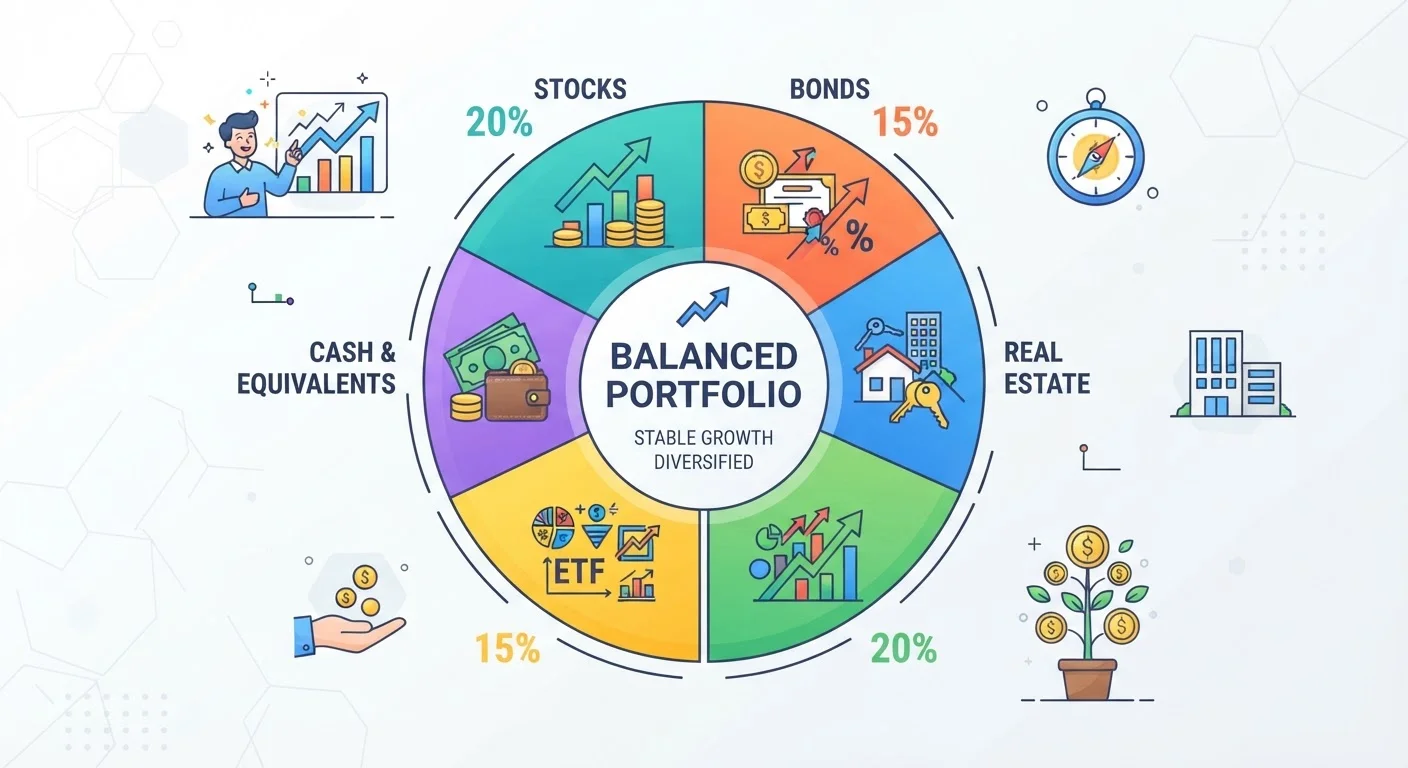
Photo credit: SearchLynk.net | Search Made Easier
In this article
Diversification is more than spreading money around. Learn the principle behind it and why it's considered a cornerstone of risk management.
Key Takeaways
- Diversification reduces risk by spreading investments across uncorrelated assets, not just across many of the same type.
- It does not guarantee profits or prevent losses - it manages the severity of potential downturns.
- True diversification spans asset classes, sectors, and sometimes geographies.
- Even a diversified portfolio carries market-wide risk that cannot be eliminated through spreading alone.
- Rebalancing periodically is necessary to keep your diversification strategy intact over time.
The Principle Behind the Practice
Most people have heard the phrase "don't put all your eggs in one basket." Diversification is the formal financial application of that idea - but it goes deeper than simply owning a lot of different things.
The underlying principle is correlation. Two investments are correlated when they tend to move in the same direction at the same time. If you own ten stocks that all rise and fall together, you haven't actually reduced your risk - you've just multiplied your exposure to a single pattern. True diversification means holding assets that behave differently from one another, so a loss in one area isn't automatically echoed across everything else you own.
Understanding this distinction matters because it changes how you think about building a portfolio. The goal isn't maximum variety for its own sake - it's meaningful variety that actually reduces the volatility of your overall holdings. For a deeper look at why risk and potential reward move together, see our guide on risk and return.
“Diversification is protection against ignorance. It makes little sense if you know what you are doing.”
— Warren Buffett, Chairman and CEO of Berkshire Hathaway, widely cited investor
What Gets Diversified - and How
Diversification typically operates across several dimensions:
- Asset classes: Stocks, bonds, real estate, and cash equivalents tend to respond differently to economic conditions. When stock markets decline sharply, bonds sometimes hold their value or rise, providing a partial offset.
- Sectors and industries: Within stocks, spreading across technology, healthcare, energy, consumer goods, and financials means one struggling industry doesn't define your returns.
- Geography: Domestic and international markets don't always move in sync. Adding international exposure introduces different economic cycles and currencies into the mix.
- Time horizon: Holding investments with different maturity dates or liquidity profiles adds another layer of balance.
Importantly, diversification does not eliminate what's called systematic risk - the market-wide risk that affects nearly all investments during a broad economic crisis. It addresses unsystematic risk: the specific risk tied to any single company, sector, or region.
~20-30
Stocks needed for significant diversification benefit
Academic research in portfolio theory, including foundational work by Edwin Elton and Martin Gruber, suggests that most unsystematic risk is substantially reduced with a portfolio of around 20-30 uncorrelated stocks.
~50%
Risk reduction possible through diversification
Studies in modern portfolio theory estimate that diversification can eliminate roughly half of a stock portfolio's total risk by removing company-specific and sector-specific volatility.
What Diversification Does - and Doesn't - Do
Diversification is widely considered a cornerstone of sound investing because it lets investors pursue growth while placing a ceiling on how much damage any single bad outcome can cause. A well-diversified portfolio won't outperform a concentrated bet on the right stock - but it also won't collapse when a single company files for bankruptcy or a single sector enters a prolonged slump.
This is the trade-off: diversification typically smooths returns over time rather than maximizing them in any given period. For long-term investors, that stability can be more valuable than chasing the highest possible short-term gain.
It's also worth noting that diversification requires maintenance. As some investments grow faster than others, your original allocation drifts. Periodic rebalancing - selling what has grown beyond its target weight and adding to what has lagged - keeps the strategy intact. For clarity on terms like rebalancing and others that often confuse new investors, this breakdown of commonly misunderstood financial terms is a useful reference.
Putting It Into Practice
For investors just starting out, the mechanics of diversification can feel overwhelming. The good news is that the investment landscape now includes tools designed specifically to make broad diversification accessible. Index funds and exchange-traded funds (ETFs) pool money across dozens or hundreds of securities, giving a single investor exposure to an entire market segment in one purchase.
When you're ready to put these ideas to work, building your first investment portfolio walks through how to match your diversification approach to your goals and risk tolerance. And if you want to understand how spreading investments interacts with long-term growth mechanics, compound interest and long-term wealth building adds important context.
This article is for general informational and educational purposes only and does not constitute personalized financial, investment, or tax advice. Consult a qualified financial professional before making decisions about your own investments.
Frequently Asked Questions

Author
Finance Editorial Team
Finance Editorial Team is the collective byline for our editorial team and contributor network. Articles published under this byline or an editorial pen name are researched, written, and reviewed according to our editorial standards for clarity, consistency, and independence before publication.
View all articles →