
London vs. Edinburgh: Two Very Different Introductions to Britain
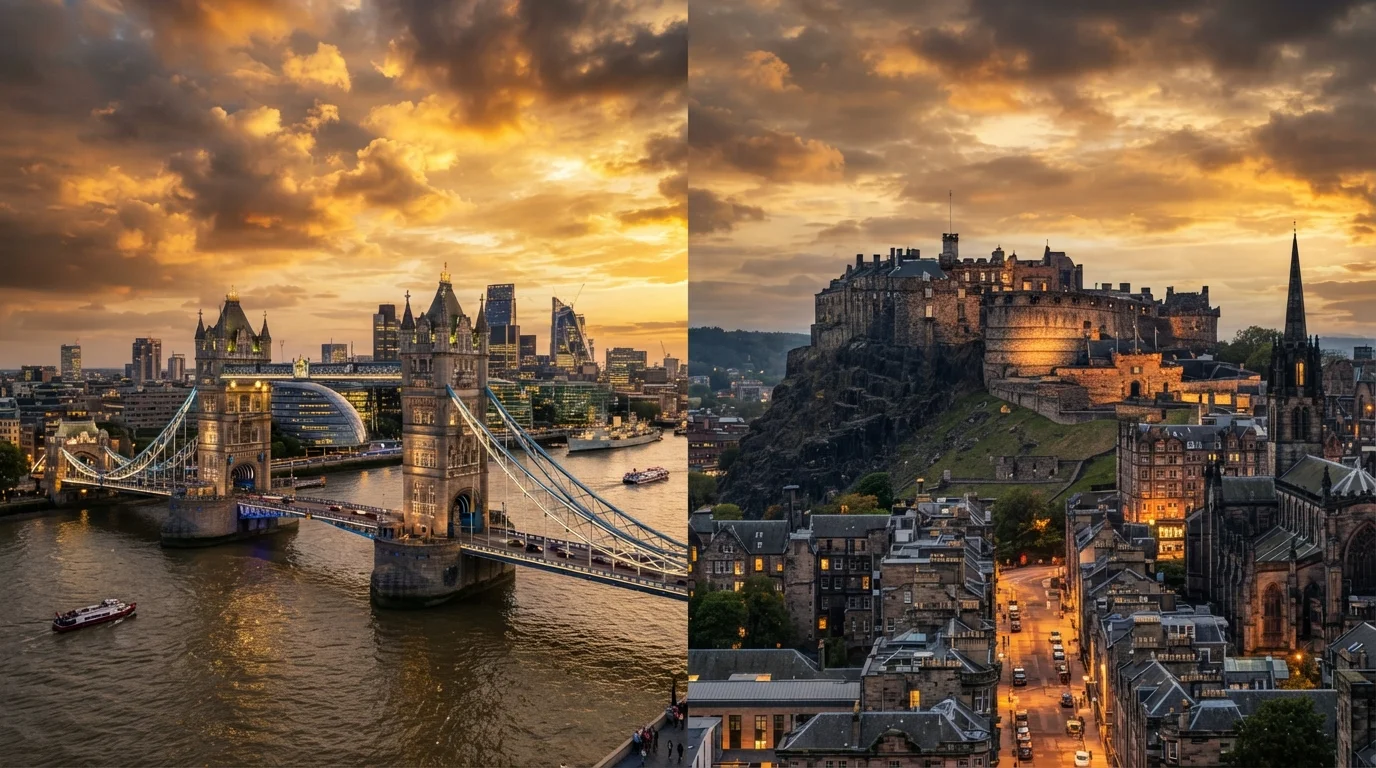
Photo credit: SearchLynk.net | Search Made Easier
In this article
Both cities are steeped in history but feel worlds apart. This side-by-side look at London and Edinburgh helps you decide which fits your travel style better.
Key Takeaways
- London is significantly larger than Edinburgh, requiring more time and planning to cover its highlights.
- Edinburgh is walkable and compact, making it well-suited to shorter trips or first-time visitors to Scotland.
- Both cities offer exceptional history, but London skews cosmopolitan while Edinburgh feels distinctly Scottish.
- London has a broader range of accommodation and price points; Edinburgh can feel competitive during peak festival season.
- Edinburgh's proximity to the Scottish Highlands makes it a strong base for day trips into dramatic countryside.
- Neither city is definitively better - your ideal choice depends on travel pace, budget, and interests.
Scale and Layout: Big City vs. Human-Sized Capital
London is one of the largest cities in Europe, home to roughly 9 million people spread across 32 boroughs. Getting from one major attraction to another often means navigating the Underground (the Tube), buses, or taxis. Edinburgh, by contrast, houses around 500,000 people and can be crossed on foot in under an hour. Its two historic districts - the medieval Old Town and the Georgian New Town - sit within easy walking distance of each other.
This difference in scale shapes the entire experience. In London, you'll need to budget significant time just for transit. In Edinburgh, spontaneity is easier: you can wander from the Royal Mile to Calton Hill to Grassmarket without consulting a transport app. For first-time visitors to Britain who feel nervous about navigating a massive city, Edinburgh's layout can feel genuinely reassuring.
| Criterion | London | Edinburgh |
|---|---|---|
| Population | ~9 million | ~500,000 |
| Walkability | Low - transit-dependent | High - mostly walkable |
| Atmosphere | Cosmopolitan, diverse | Medieval, distinctly Scottish |
| General cost level | High | Moderate (spikes in August) |
| International flight access | Major global hub | Good European connections |
| Day trips to nature | Limited from city center | Highlands accessible |
| Recommended trip length | 4-7+ days | 2-4 days |
History and Atmosphere: Imperial vs. Medieval
Both cities carry extraordinary historical weight, but the texture of that history feels completely different. London's story is imperial and expansive - you'll find it in the Tower of London, the grandeur of Westminster, and the world-class collections at the British Museum. The city is intensely multicultural, shaped by centuries of global trade and migration, and that diversity shows up in its food, architecture, and street life.
Edinburgh's history is more compact and confrontational. The Castle looming over the Old Town, the narrow closes (alleyways) running off the Royal Mile, and the Holyrood Palace at the foot of the hill all tell a story of Scottish royalty, religious conflict, and Enlightenment thought. It's a city where the past feels physically close. Walking the cobblestones at dusk, with volcanic rock rising above the rooftops, produces an atmosphere that's hard to replicate anywhere else in Britain.
A Note on Scottish vs. British Identity
Scotland is part of Great Britain, but Edinburgh is emphatically not "just another British city." Scottish culture, law, and education systems are distinct from England's, and locals are proud of that difference. Visitors often find Edinburghers warm and forthcoming - but it's worth knowing that conflating "Scottish" with "English" is a common faux pas. Engaging with local culture and history respectfully goes a long way.
Practical Considerations: Cost, Crowds, and Timing
London consistently ranks among the more expensive cities in the world for travelers. Accommodation, dining, and attraction entry costs add up quickly, though the city's many free world-class museums (the Natural History Museum, the V&A, the National Gallery) help offset that significantly. Edinburgh is generally more affordable day-to-day, but accommodation prices spike sharply each August during the Edinburgh Festival Fringe - the world's largest arts festival - when the city fills to capacity.
~3,500
Shows at Edinburgh Festival Fringe annually
The Edinburgh Festival Fringe is widely cited as the world's largest arts festival, running each August across hundreds of venues throughout the city.
~30M
Overnight visits to London per year
Visit Britain has reported London consistently attracting tens of millions of international and domestic overnight visitors annually, making it one of the world's most visited cities.
Both cities are year-round destinations with peak summer crowds. Spring (April-May) and early autumn (September-October) tend to offer a balance of reasonable weather and thinner tourist queues. Edinburgh in winter has its own appeal, particularly around Hogmanay, the city's celebrated New Year's Eve festival, which is deeply rooted in Scottish tradition. Travelers should always check official tourism and government sources for current entry requirements, travel advisories, and any seasonal event-related accommodation constraints before booking.
Which Should You Visit - or Should You Do Both?
If you have only one trip to Britain and want the broadest possible introduction - global culture, iconic landmarks, and easy onward flight connections - London is the practical starting point. If you're drawn to a more intimate, character-rich city with an unmistakably Scottish identity and easy access to the countryside, Edinburgh delivers something London simply can't.
The good news: the two cities are connected by direct train services (journey times roughly 4.5 hours on the East Coast Main Line) and frequent flights, making a combined trip genuinely viable. Many travelers choose to fly into one city and out of the other, experiencing both without backtracking. If that's your plan, allow at least three full days in each to do both justice - more if you intend to take day trips or attend festivals.

Author
Travel & Trips Editorial Team
Travel & Trips Editorial Team is the collective byline for our editorial team and contributor network. Articles published under this byline or an editorial pen name are researched, written, and reviewed according to our editorial standards for clarity, consistency, and independence before publication.
View all articles →