
What Customer Reviews Actually Reveal-and What They Reliably Hide
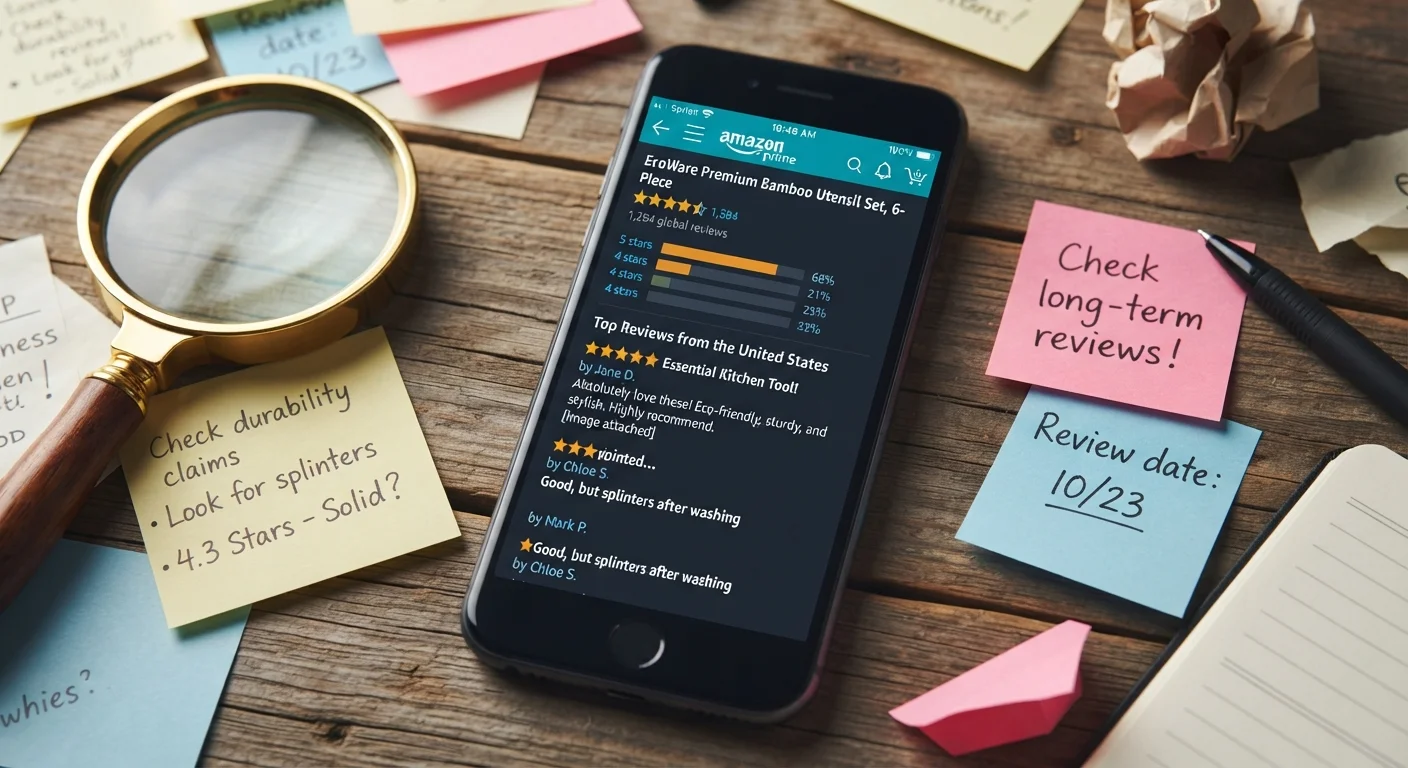
Photo credit: SearchLynk.net | Search Made Easier
In this article
Star ratings and review counts can mislead as easily as inform. Learn to read between the lines and spot patterns that matter before making a purchase.
Key Takeaways
- A high average star rating can mask a deeply divided or manipulated reviewer pool.
- Review text patterns - not just scores - reveal whether feedback is authentic and relevant to your use case.
- Negative reviews are often more informative than positive ones when read carefully.
- Verified purchase labels, review dates, and reviewer history are critical credibility signals.
- Platforms vary widely in how aggressively they police fake or incentivized reviews.
Why Star Ratings Are an Incomplete Signal
A 4.6-star average sounds reassuring - until you learn it was calculated from 12 reviews, three of which were posted on the same day by accounts with no prior history. Star ratings compress a wide range of experience into a single number, and that compression throws away exactly the context you need.
Two products can share an identical average while telling completely different stories. One might have 90% five-star reviews and 10% one-star reviews from buyers who received a defective unit. Another might have a tightly clustered range of three- to four-star scores, reflecting consistent but unexceptional quality. The averages match; the products don't.
42%
Online reviews estimated to be unreliable or fake
A 2023 analysis by the World Economic Forum estimated that a substantial share of online product reviews across major platforms may be fake, incentivized, or otherwise unreliable.
1 in 5
Consumers who have written a review after incentive
Survey data cited by consumer advocacy groups suggests a significant minority of reviewers have received a discount, free product, or other benefit in exchange for posting feedback.
Before trusting any aggregate score, look at the full distribution. A polarized histogram - heavy at the top and bottom, thin in the middle - often signals that something unusual is happening, whether that's a manufacturing inconsistency, a fulfillment problem, or coordinated review activity.
What Review Text Actually Reveals
The written portion of a review carries information a star rating never can. Reviewers who describe specific use cases, name particular product features, and mention how long they've owned the item are far more credible than those offering vague praise.
Look for language patterns. Generic five-star reviews that read like marketing copy - "Amazing quality! Fast shipping! Would recommend!" - provide almost no signal. Contrast those with detailed four-star reviews that say "The zipper is solid but the lining is thinner than expected at this price point." The latter tells you something you can act on.
Read the lowest-rated reviews before the highest-rated ones.
Negative reviews surface failure modes, durability problems, and customer service issues that satisfied buyers never experience. Starting there gives you a more complete risk picture before positive sentiment creates anchoring bias.
Filter reviews to match your specific use case.
A product rated by buyers who use it differently than you plan to offers limited predictive value for your experience. Platforms that allow keyword filtering inside reviews let you find the subset of feedback most relevant to your actual needs.
Check reviewer account history before weighting their opinion.
Accounts that have reviewed only one brand, reviewed dozens of products in a short time window, or have no profile history are less trustworthy than established reviewers with diverse, long-term activity.
Note the date range of reviews, not just the total count.
Products change - manufacturers alter materials, switch suppliers, or modify designs without updating the listing. Reviews older than 12 to 18 months may describe a different version of the product than the one currently shipped.
Look at how sellers respond to critical reviews.
Seller responses to negative feedback reveal how a company handles problems in practice, not just in policy. Defensive, dismissive, or absent responses are as informative as the complaint itself.
Negative reviews deserve special attention. A one-star review that describes a specific failure mode, documents the return process, or mentions how the seller responded is genuinely useful. One that says "garbage, do not buy" without elaboration is not. Sort reviews by lowest rating and read them critically rather than dismissively - they often surface durability or customer service problems that positive reviewers never encountered.
Spotting Manipulation and Inauthenticity
Review manipulation is widespread enough that the Federal Trade Commission has issued guidance requiring disclosure of any incentive given in exchange for a review. Despite this, incentivized and outright fake reviews remain common, particularly on open marketplace platforms.
Cross-Check Reviews on a Second Platform
The same product sold across multiple platforms often accumulates independent review pools. Comparing feedback from two different marketplaces - where review manipulation ecosystems differ - can quickly surface inconsistencies that suggest a problem on one platform. If a product has glowing reviews in one place and mediocre ones elsewhere, that gap is worth investigating before purchasing.
Key signals of inauthentic reviews include: a sudden surge of five-star feedback after a long quiet period; reviewers whose entire account history covers only one brand or seller; reviews that are identical or nearly identical in phrasing; and feedback posted before the product's listed availability date. None of these signals is definitive on its own, but clusters of them warrant skepticism.
Third-party tools exist that analyze review authenticity for popular platforms, though no tool is perfectly accurate. Use them as one input among several, not as a final verdict. You can also check whether the platform distinguishes "verified purchase" reviews from unverified ones - a meaningful but imperfect filter. For a broader pre-purchase checklist, see what to confirm before buying online.
What Reviews Reliably Hide
Even a legitimate, unmanipulated review pool has structural blind spots. Reviews skew toward two types of buyers: those who were delighted, and those who were frustrated enough to act. The large middle group - buyers who found the product acceptable but unremarkable - rarely write anything.
Reviews also can't tell you how a product will perform for your specific situation. A hiking boot rated highly by casual trail walkers may be insufficient for multi-day backpacking. A blender praised for smoothies may struggle with tasks the reviewers never attempted. Match the reviewer's described use case to your own before weighing their score.
Packaging and product descriptions are also silent on quality signals that reviews often miss entirely. For a more systematic look at durability and craftsmanship indicators, learn what packaging and marketing won't tell you about quality. And if a listing's review count seems suspiciously high or the price seems too low for what's being described, cross-reference with red flags hidden in plain sight on product listings.
“The plural of anecdote is not data. Aggregating individual opinions into a star rating doesn't transform subjective experience into objective quality measurement - it just averages the biases.”
— A commonly cited principle in consumer research, Widely attributed across behavioral economics and consumer decision-making literature

Author
Shopping Editorial Team
Shopping Editorial Team is the collective byline for our editorial team and contributor network. Articles published under this byline or an editorial pen name are researched, written, and reviewed according to our editorial standards for clarity, consistency, and independence before publication.
View all articles →