
Tile Backer Board vs. Drywall in Wet Areas
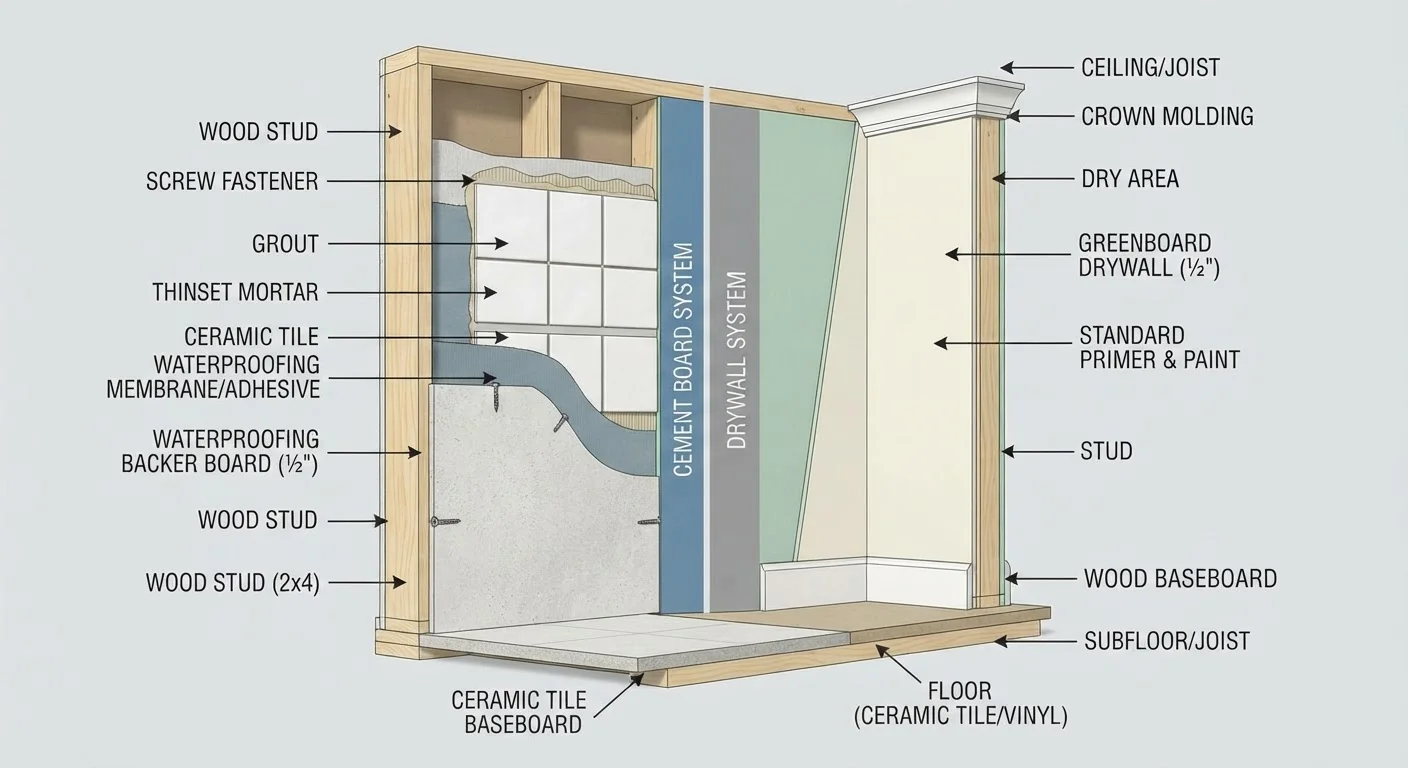
Photo credit: SearchLynk.net | Search Made Easier
In this article
Learn why substrate choice matters behind tile in bathrooms and kitchens, and what each material handles well.
Key Takeaways
- Tile backer board resists moisture absorption, making it essential in wet zones like showers and tub surrounds.
- Standard drywall can degrade, swell, and grow mold when consistently exposed to moisture behind tile.
- Cement board and foam backer board are the two most common types of tile backer materials.
- Moisture-resistant drywall (often called greenboard) is not waterproof and is unsuitable for direct water exposure.
- Local building codes often specify the required substrate for wet areas - always verify before starting a project.
- Proper waterproofing membrane application further protects any substrate in high-moisture environments.
What Each Material Is - and How It's Made
Understanding what these two substrates are made of explains most of their differences in performance.
Tile backer board is a panel product specifically engineered to go behind tile in areas prone to moisture. The most common variety is cement board, which consists of a Portland cement core reinforced with fiberglass mesh on its surfaces. It does not swell, rot, or disintegrate when wet. A second type - foam backer board (sometimes called tile foam or XPS backer) - uses a rigid, closed-cell foam core with a polymer coating. Foam boards are lighter and easier to cut while still offering excellent moisture resistance.
Drywall (also called gypsum board or sheetrock) is made from a gypsum plaster core sandwiched between paper facings. Standard drywall is not water-resistant: the paper facing and gypsum core absorb moisture readily, which leads to softening, mold growth, and structural failure. Moisture-resistant drywall - commonly known as greenboard - uses a water-repellent facing, but the core is still gypsum and can be compromised by sustained or direct moisture. Greenboard is not a substitute for backer board in wet-zone applications.
| Criterion | Tile Backer Board | Drywall |
|---|---|---|
| Moisture resistance | High - engineered for wet areas | Low to moderate (greenboard only moderate) |
| Mold risk when wet | Very low | High (standard); moderate (greenboard) |
| Structural stability when wet | Stable - does not swell or soften | Degrades - swells and softens over time |
| Weight (per sheet) | Heavier (cement); lighter (foam) | Lighter than cement board |
| Ease of cutting | Moderate (cement); easy (foam) | Easy - scores and snaps |
| Tile bond longevity | Strong - stable base for adhesive | Poor in wet zones; adhesive fails over time |
| Typical cost per sheet | Higher than drywall | Lower upfront cost |
| Suitable for shower walls | Yes - recommended | No - not code-compliant in most jurisdictions |
Performance in Wet Areas: Where the Difference Really Shows
The critical distinction between these materials comes down to what happens when water gets behind the tile - which it inevitably does to some degree through grout lines, cracks, and imperfect seals.
Tile backer board, particularly cement board, is dimensionally stable when wet. It does not expand, contract, or lose structural integrity when exposed to moisture repeatedly over time. This stability supports the bond between the tile adhesive (mortar or mastic) and the wall, which means tiles are far less likely to crack or loosen.
Standard drywall absorbs water into its gypsum core. Over months or years, this leads to softening of the substrate, which causes tile adhesive to fail. Tiles may then crack, pop off, or develop hollow spots. Worse, a damp gypsum core creates an ideal environment for mold and mildew to establish behind the tile - a problem that often goes undetected until significant damage has occurred.
For shower walls and tub surrounds, industry guidance and most local building codes require a water-resistant or waterproof substrate. Many professionals also apply a liquid waterproofing membrane directly over backer board before setting tile, adding an additional barrier. If you are completing related finishing work, such as sealing the perimeter of a tub, see our guide to caulking a bathtub surround for proper technique.
Greenboard Is Not Waterproof
Moisture-resistant drywall (greenboard) is a common source of confusion in bathroom renovations. Its water-repellent paper facing resists surface moisture, but the gypsum core will still absorb water if it is consistently exposed - for example, behind a shower tile with imperfect grout. Most building codes and tile industry guidelines do not permit greenboard as the sole substrate in direct-water zones such as showers or tub surrounds. Reserve it for low-humidity environments where occasional indirect moisture is the only concern.
Installation Considerations and Practical Trade-offs
Both materials have trade-offs beyond moisture performance that are worth knowing before you start.
Weight: Cement board is noticeably heavier than drywall, which makes handling large sheets on walls or ceilings more physically demanding. Foam backer boards address this, though they are generally pricier.
Cutting: Drywall scores and snaps cleanly with a utility knife. Cement board requires scoring and snapping or cutting with a carbide-tipped blade or grinder - a dusty process best done outdoors or with respiratory protection. Foam boards cut easily with a utility knife, similar to drywall.
Fastening: Both materials attach to studs with appropriate screws (use alkali-resistant screws for cement board). Joints on cement board should be taped with fiberglass mesh tape and thinset mortar - not standard joint compound.
Cost: Tile backer board generally costs more per sheet than standard drywall, but this upfront difference is minor compared to the cost of remedying water damage or retiling a failed installation.
Permits and codes: Wet-area substrate requirements are addressed in many local residential building codes. Before beginning any tiled bathroom or wet-area project, verify your jurisdiction's specific requirements. When in doubt, consult a licensed contractor or your local building department.
~10 years
Typical time before water-damaged drywall tile fails
Industry tile installers commonly observe grout cracking and tile delamination within a decade when drywall is used in wet-zone applications.
~30%
Weight reduction with foam vs. cement backer board
Foam-core backer boards can weigh roughly 30% less than equivalent cement board panels, easing handling during solo installation.

Author
Home & Garden Editorial Team
Home & Garden Editorial Team is the collective byline for our editorial team and contributor network. Articles published under this byline or an editorial pen name are researched, written, and reviewed according to our editorial standards for clarity, consistency, and independence before publication.
View all articles →