
Insulation Types Compared: Fiberglass, Spray Foam, Rigid Board, and Cellulose
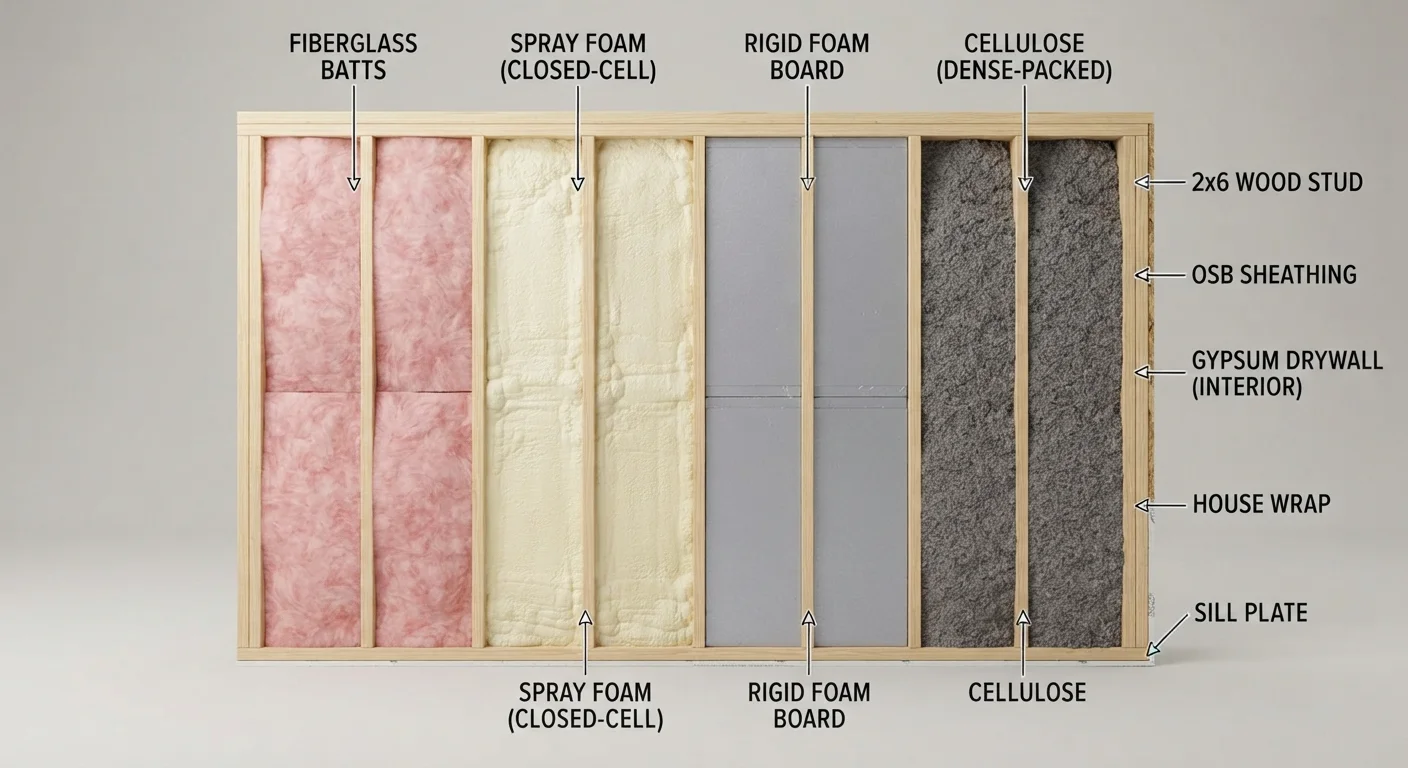
Photo credit: SearchLynk.net | Search Made Easier
In this article
Compare the four most common insulation materials across R-value, cost, installation needs, and best-fit applications.
Key Takeaways
- R-value measures thermal resistance - higher R-value means better insulating performance per inch.
- Spray foam offers the highest air-sealing capability but requires professional installation for most applications.
- Fiberglass batts are the most DIY-friendly option and widely available at home improvement stores.
- Cellulose is a recycled-content option well suited to attic floors and existing wall cavities.
- Rigid board insulation excels in areas where moisture resistance and thin profiles matter most.
What R-Value Means and Why It Matters
Before comparing materials, it helps to understand R-value - the measure of thermal resistance that tells you how well an insulation material slows heat transfer. A higher R-value means better insulating performance. The U.S. Department of Energy recommends different R-values depending on your climate zone and which part of the home you're insulating; attics generally require higher R-values than interior walls.
R-value is additive - layering materials increases total resistance - but it only measures heat conduction, not air leakage. A material with a high R-value but poor air sealing can still allow significant energy loss through gaps and cracks. Keep both factors in mind as you evaluate each option.
| Fiberglass Batts | Spray Foam | Rigid Board | Cellulose | |
|---|---|---|---|---|
| R-value per inch | R-2.9 to R-3.8 | R-3.5 to R-7 | R-5 to R-6.5 | R-3.2 to R-3.8 |
| Air sealing ability | Low | Excellent | Moderate (taped seams) | Moderate (dense-pack) |
| Moisture resistance | Moderate | High (closed-cell) | High (XPS/polyiso) | Low to moderate |
| DIY accessibility | High | Low (small gaps only) | Moderate | Moderate (attic) |
| Relative material cost | Low | High | Moderate to high | Low to moderate |
| Best application | Walls, attics | Crawl spaces, rim joists | Exterior sheathing, slabs | Attic floors, existing walls |
Fiberglass: The Familiar Standard
Fiberglass insulation comes in two main forms: batts (pre-cut blankets fitted between studs) and loose-fill (blown into attic floors or wall cavities). Batts are the most DIY-accessible insulation product available, requiring only basic cutting tools and protective gear - gloves, eye protection, and a dust mask are essential since glass fibers can irritate skin and lungs.
Fiberglass batts typically deliver R-2.9 to R-3.8 per inch. They're moisture-resistant but not waterproof; prolonged dampness can cause the facing to mold and reduce effectiveness. Standard batts do not air-seal on their own, so pairing them with a vapor barrier or air-sealing caulk around penetrations is important for optimal performance.
Combine Materials for Best Results
Many contractors and experienced DIYers use a hybrid approach - for example, spray foam to air-seal rim joists and around penetrations, then fiberglass batts to fill the remaining wall cavity. Combining materials lets you address both air sealing and R-value goals cost-effectively. Always verify your planned assembly meets local building code requirements before proceeding.
Spray Foam: High Performance, Professional Installation
Spray polyurethane foam (SPF) expands on contact to fill gaps, cracks, and irregular spaces, making it the most effective air barrier of the four materials. It comes in two types: open-cell foam (softer, lower density, R-3.5 to R-3.7 per inch) and closed-cell foam (rigid, moisture-resistant, R-6 to R-7 per inch).
Closed-cell spray foam is especially valuable in crawl spaces, rim joists, and basement walls where moisture intrusion is a concern. However, professional installation is strongly recommended - mixing and applying two-component foam requires specialized equipment and safety precautions. Small cans of one-component foam are DIY-suitable for sealing gaps around pipes and window frames, but whole-wall or large-area applications should be handled by a licensed contractor.
Note: Spray foam installation in enclosed spaces requires proper ventilation and respiratory protection. Always consult a licensed professional for large-scale applications.
Rigid Board: Thin Profile, Moisture Resistance
Rigid insulation panels - commonly made from expanded polystyrene (EPS), extruded polystyrene (XPS), or polyisocyanurate (polyiso) - offer high R-values in a thin, manageable profile. Polyiso boards can reach R-6 to R-6.5 per inch, while XPS typically delivers R-5 per inch.
Rigid board is well suited for exterior wall sheathing, under concrete slabs, and along basement or foundation walls where continuous insulation without thermal bridging is the goal. Thermal bridging occurs when studs or framing members conduct heat around insulation, reducing overall efficiency - rigid board on the exterior of the wall assembly addresses this effectively.
Cutting rigid board requires a utility knife or circular saw. Some products, particularly XPS, have faced scrutiny for their higher global warming potential due to blowing agents used in manufacturing - EPS is generally considered the more environmentally moderate option among rigid boards.
Cellulose: Recycled Content, Dense-Pack Performance
Cellulose insulation is made primarily from recycled paper products - typically newsprint - treated with fire retardants such as borate. Loose-fill cellulose delivers approximately R-3.2 to R-3.8 per inch and is commonly blown into attic floors or dense-packed into existing wall cavities without major demolition.
Its density when professionally dense-packed gives cellulose a meaningful advantage in reducing air infiltration compared to standard fiberglass batts. It also has good sound-dampening properties. One consideration: cellulose can absorb moisture, so it is not recommended for areas with chronic water exposure. Settling over time is also a factor in attic applications - initial installation should account for this by slightly overfilling to meet the target R-value after settling occurs.
DIY attic installation using a rented blowing machine is feasible and relatively common, though dense-packing existing walls generally requires professional equipment and experience to achieve consistent density throughout the cavity.

Author
Home & Garden Editorial Team
Home & Garden Editorial Team is the collective byline for our editorial team and contributor network. Articles published under this byline or an editorial pen name are researched, written, and reviewed according to our editorial standards for clarity, consistency, and independence before publication.
View all articles →