
Engineered Hardwood vs. Solid Hardwood Flooring
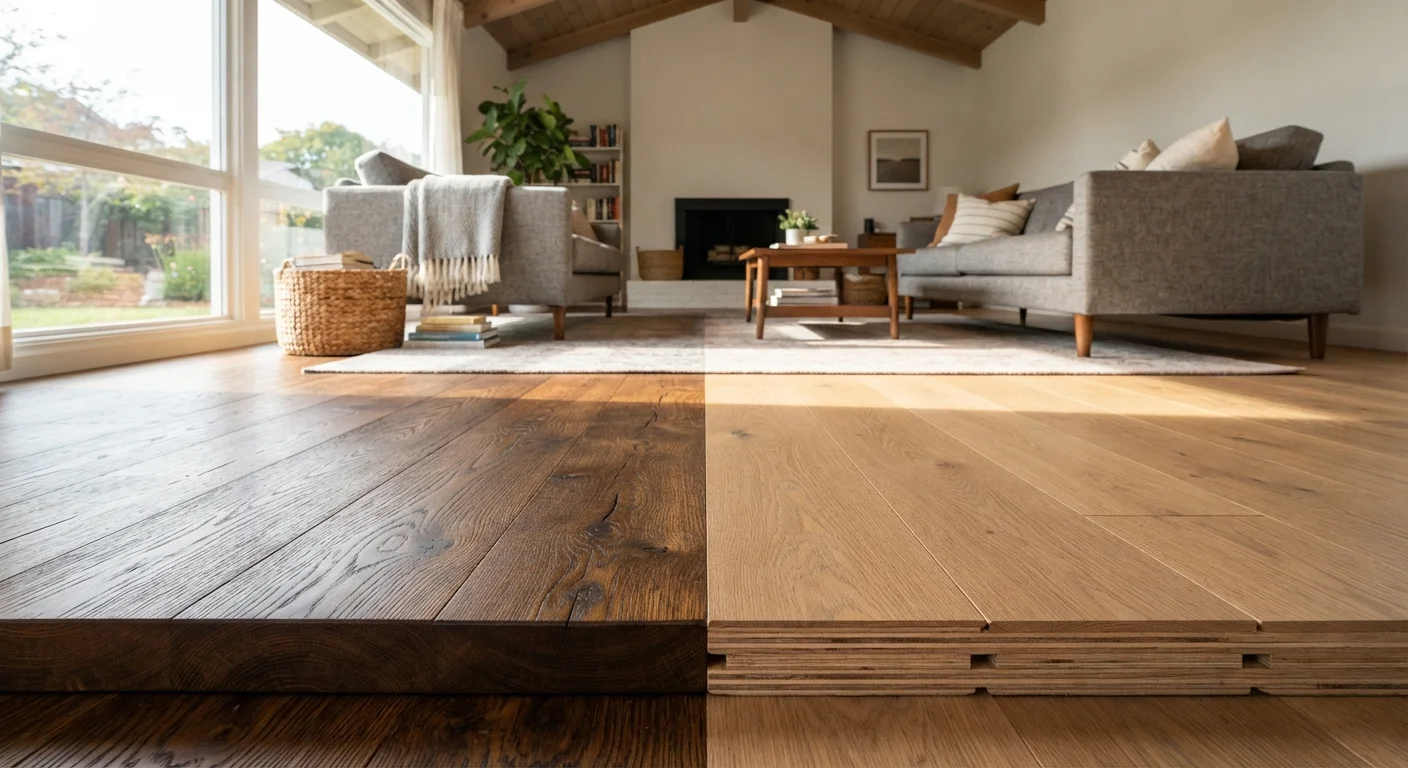
Photo credit: SearchLynk.net | Search Made Easier
In this article
How engineered and solid hardwood differ in construction, stability, refinishing potential, and suitability by room and climate.
Key Takeaways
- Engineered hardwood resists humidity-driven expansion better than solid hardwood due to its layered construction.
- Solid hardwood can typically be sanded and refinished more times over its lifespan than engineered hardwood.
- Engineered hardwood is generally suitable for basements and over radiant heat; solid hardwood is not recommended for either.
- Both types are genuine wood products, though only solid hardwood is made entirely from a single species throughout.
- Installation method and subfloor type can be deciding factors between the two products.
How Each Floor Is Actually Built
Understanding construction is the fastest way to predict how each flooring type will behave in your home.
Solid hardwood is milled from a single piece of wood - typically ¾ inch thick - cut from species such as oak, maple, or hickory. Because it is one continuous piece throughout, it expands and contracts significantly as indoor humidity rises and falls. This movement is normal and manageable with proper acclimation and installation gaps, but it does limit where solid hardwood can be used.
Engineered hardwood is constructed from multiple layers: a real hardwood veneer on top (the wear layer), bonded to a core of cross-directional plywood or high-density fiberboard. This cross-grain construction counteracts the natural tendency of wood to move with moisture, making engineered hardwood dimensionally stable across a wider range of conditions. Importantly, the surface you see and walk on is genuine hardwood - not a photographic print.
| Criterion | Engineered Hardwood | Solid Hardwood |
|---|---|---|
| Construction | Hardwood veneer over plywood core | Single solid wood piece throughout |
| Moisture resistance | Higher - stable across humidity swings | Lower - expands and contracts with humidity |
| Basement / below-grade use | Generally suitable | Not recommended |
| Radiant heat compatibility | Yes, if product-rated | Not recommended |
| Refinishing potential | 1-3 times (wear-layer dependent) | 4-6 times over lifespan |
| Installation methods | Nail, glue, or floating click-lock | Nail or staple only |
| Typical plank thickness | ⅜ - ¾ inch | ¾ inch (standard) |
Stability, Moisture, and Room Suitability
Moisture is the single biggest differentiator when choosing between these two products.
Solid hardwood is generally recommended only for above-grade installations - main floors and upper levels - in rooms where relative humidity stays between roughly 35% and 55% year-round. It should not be installed in basements or directly over radiant heating systems, where heat cycles can cause the boards to gap or cup.
Engineered hardwood's layered core tolerates a broader humidity range and performs reliably in basements, kitchens, and over in-floor heating, provided the specific product is rated for that use. Always verify the manufacturer's installation guidelines for moisture thresholds before purchasing, as products vary.
35-55%
Recommended indoor relative humidity for hardwood floors
The National Wood Flooring Association (NWFA) identifies this humidity range as the appropriate service condition for most hardwood flooring products.
1-6 mm
Typical engineered hardwood wear-layer thickness range
Wear-layer thickness directly determines how many times an engineered floor can be sanded and refinished - thicker veneers offer more refinishing cycles.
4-6x
Estimated refinishing cycles for solid hardwood
A standard ¾-inch solid hardwood plank can typically support multiple sanding and refinishing treatments before the tongue-and-groove structure is compromised.
In climates with dramatic seasonal swings between summer humidity and dry winter air - common across much of the Midwest and Northeast - engineered hardwood typically requires less seasonal management than solid planks.
Refinishing, Longevity, and Care
One of the most frequently cited advantages of solid hardwood is its refinishing potential. Because solid boards are ¾ inch thick, they can typically be sanded and refinished four to six times over their lifetime, allowing homeowners to remove scratches, change stain colors, or refresh worn surfaces decades apart.
Engineered hardwood's refinishing capacity depends almost entirely on the thickness of its top veneer, which typically ranges from 1-6 mm depending on the product. Thinner wear layers (1-2 mm) may allow only one light sanding; thicker veneers (4-6 mm) can support two or three refinishes. Check the wear-layer specification before purchasing if refinishing is a long-term priority.
Day-to-day care is largely the same for both types: sweep regularly to remove abrasive grit, use manufacturer-approved hardwood floor cleaners, avoid excessive water, and place felt pads under furniture legs. Neither type should be wet-mopped.
Acclimation Matters for Both Types
Before installation, both solid and engineered hardwood should be acclimated to the room's temperature and humidity - typically for 48-72 hours minimum, though manufacturer guidelines vary. Skipping this step can lead to post-installation gapping or buckling. Store planks flat, in the room where they'll be installed, and ensure the space is at its normal living conditions (HVAC running, windows closed) during acclimation.
Installation Methods and Cost Considerations
Both flooring types can be nail-down or staple-down installed over a wood subfloor. Beyond that, the options diverge.
Solid hardwood must be fastened - it cannot float freely, as movement would cause locking joints to fail. It also requires a wood subfloor and cannot be glued directly to concrete without a plywood underlayment layer. Most solid hardwood installation requires professional tools and experience, particularly for cutting around door casings and transitions.
Engineered hardwood offers more flexibility: it can be nailed, stapled, glued (directly to concrete in some cases), or floated using a click-lock system. The floating method is the most DIY-accessible approach and eliminates adhesive or fastener costs.
In general, solid hardwood materials carry a higher price per square foot than comparable engineered products, though installation costs can close that gap depending on method and labor market. Both represent a long-term investment - with proper care, either floor can last several decades.
This article provides general home improvement information only. Costs, installation requirements, and product performance vary by manufacturer and region. Consult a licensed flooring professional for guidance specific to your home and subfloor conditions.

Author
Home & Garden Editorial Team
Home & Garden Editorial Team is the collective byline for our editorial team and contributor network. Articles published under this byline or an editorial pen name are researched, written, and reviewed according to our editorial standards for clarity, consistency, and independence before publication.
View all articles →